Save cash by going green
Masonry firm Absolute Tile and Stone wants to update its business to be more environmentally friendly - profitably.



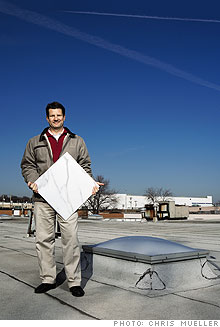 |
| Absolute Tile President Sander Coovert |
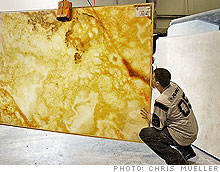 |
| Employee Ken Eilermann moves a slab of honey onyx. |
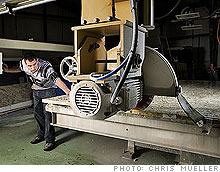 |
| Cutting granite |



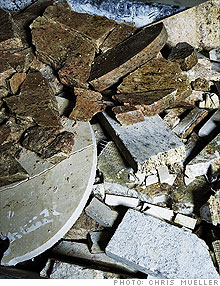 |
| Absolute's scrap leftovers |
(Fortune Small Business) -- In early 2008, Sander Coovert was feeling pretty good about his business, Absolute Tile and Stone. The previous year had ended with sales up 27%, to $2.8 million, at the St. Louis company, which cuts tile and slabs of marble and granite and installs them in residential kitchens and bathrooms. That year Coovert, 40, saw his largest profit ever. But by the end of 2008, as the housing bubble burst and the recession hit, revenue dropped to $2.1 million and the company lost money.
Marketing has always been a problem at the 15-person firm. Contractors value Absolute's top-notch craftsmanship and customer service. But Coovert is Absolute's sole spokesperson, and he struggles to communicate his company's strengths to new clients. Last year he toyed briefly with a Google (GOOG, Fortune 500) AdWords campaign, but although it boosted traffic to his Web site, it didn't generate sales.
"I'm trying to figure out how to manage through a down period," Coovert says wearily. "But I'm pulled in so many directions. I can only do so much."
Coovert has chosen to begin by reducing waste at his firm, a move that will cut costs and also give him an edge among increasingly eco-conscious consumers. To help him thrive while walking the green walk, Fortune Small Business sent three experts to Absolute's offices.
The first to arrive is Tim Michels of Energy Solutions, an energy-efficiency consultancy in St. Louis. He gets right to the point as he enters the room.
"This is way too much light for the space. Your eyes must strain against the glare," Michels says as he gestures at the 24 four-bulb fluorescent fixtures in the 2,000-square-foot main room, which accommodates six computer terminals and a conference table. "We can cut the lighting in half."
Michels suggests removing at least two bulbs from each overhead fixture in circulation areas. And, he says, fixtures above the desks should be removed altogether because they create glare on the computer screens and shadows on the workspaces. He suggests replacing them with one or two small gooseneck lamps on each desk.
"Why waste energy creating discomfort when what you really need is more direct light?" Michels asks. He notes that the fixtures take T12 bulbs, an older and less efficient technology. Retrofitting them with new ballasts that take T8 bulbs would greatly reduce energy use. (Michels also reminds Coovert that the firm is required by law to dispose of all strip lights through a licensed fluorescent bulb recycler.)
Next, Michels points to an empty office - and he's not happy. "That light shouldn't be on," he says.
He advises Coovert to install occupancy sensors, which ensure that lights switch on only when someone enters a room. Michels estimates that these lighting fixes would cost Coovert more than $1,000, but they would also result in savings of 14%, or $350, on his annual electricity bill, paying for the change and generating savings within three years.
Based on data he obtained from the local utility company, Michels is especially concerned about the electricity Absolute wastes during the summer. A graph depicting Absolute's power use shows that 40% of its energy dollars are spent when the average daily temperature is above 60°F.
"We can't keep this room cool," Coovert explains. "We have to leave the air conditioning on all night to make it comfortable by morning."
"That tells me you haven't got much insulation on your roof," says Michels. "There's 2,000 square feet of hot black tar up there radiating heat downward."
He says the cheapest solution would be to coat the roof with aluminum paint, which would reflect much of the sun's heat. Until it's time to replace the roof, insulating it may be too expensive to produce a rapid payback. But Michels urges Coovert to insulate his building's cement walls.
"In the winter there must be constant heat loss to the outside and your warehouse next door," Michels says, adding that the wall temperature is as important as the air temperature. "If you have a cold ceiling or wall, you'll be uncomfortable even if the thermostat says 72." Michels estimates that treating the walls and painting the roof would cost Coovert about $1,000 in materials but could save him more than $300 in annual gas and electric bills.
Next up is Jean Ponzi, green resources manager at EarthWays Center, a division of the Missouri Botanical Garden in St. Louis. She will focus on how Absolute can cut waste so that it can legitimately market itself as an environmentally conscious business. First, Ponzi asks how Coovert disposes of the thousands of pounds of stone remnants that Absolute produces annually.
"They currently go to a landfill," Coovert admits sheepishly.
"Zero waste is a sustainability principle," Ponzi says. "So you need to find uses for these pieces of stone." She suggests that Coovert sign up with a local industrial-materials exchange, an online listings service that pairs waste producers with waste users. Taking this step could produce savings for Absolute.
"You'd have to sell at a low price, and there may be transportation costs, but hopefully you'd spend less than you do for disposal," she says.
The demand for Absolute's waste could be great. Coovert lists at least three firms that make countertops out of composite materials, and Ponzi points out that the U.S. Green Building Council's LEED (Leadership in Energy and Environmental Design) certification system awards points to builders who use local scrap materials.
Ponzi notes that limiting office (as opposed to production) waste won't yield a major financial payback. Still, she urges that recycling be made easy for employees. "
To market yourself as an environmentally conscious company, you've got to walk the talk," she says. Ponzi suggests placing recycling bins next to all trash cans and posting reminders throughout the building. She advises Coovert to simplify recycling by hiring a hauler that doesn't require the separation of paper, plastic and glass.
Ponzi believes Coovert could tell a marketable earth-friendly story. If he finds a taker for his stone fragments, she says, he should nominate his firm for local waste-reduction awards, like those offered by the Missouri Waste Control Coalition. She also encourages him to join professional networks, such as the U.S. Green Building Council, where he'll find green builders and decorators who are seeking similarly conscientious suppliers.
Ponzi adds that if Absolute's brochures or business cards are printed on postconsumer recycled paper, Coovert should tout that fact on those materials and consider detailing his efforts on the firm's Web site.
Now that Coovert has been schooled on green initiatives, Mark Birsinger, a business consultant in St. Louis, is eager to offer sales and marketing guidance. He wants to know the sources of Absolute's business.
"About 10% comes from referrals, and the rest from contractors who are already customers," says Coovert. He adds that he rarely gets business through his Web site. Birsinger isn't surprised.
"Your Web site is almost entirely invisible to an Internet search engine!" he exclaims. As for the company's brief Google AdWords campaign, Birsinger dismisses it as a money waster. "You were paying for something you can get for free," he says.
For Absolute's Web site to appear on the first page of results from a relevant search, Birsinger says, it must be updated to ensure that key search terms are in all the right spots, such as within Web page titles. Once the pages are retooled, Birsinger advises Coovert to manually submit each one to the Google, Yahoo (YHOO, Fortune 500) and MSN search engines every 90 days to make sure his site remains highly ranked.
"Google will tell you to submit the home page and let its algorithm crawl the rest of the site," Birsinger says. "But you're better off submitting each page."
The real challenge becomes clear when Coovert admits to using a seat-of-the-pants marketing strategy: Whenever he sees a house being built, he shows up on the job site with his business cards and portfolio to ask the site manager if he needs any tile or stone work. And he occasionally makes presentations to builders and interior decorators.
Birsinger advises Coovert to hire a sales representative to find new leads, which would allow him to focus on what he does best: creating beautiful stone projects and nurturing client relationships. He also says Coovert should try to get in front of professionals who can sell his products for him, such as members of the local chapter of the American Society of Interior Decorators. And he should offer his employees commissions for bringing in good jobs.
Finally, Birsinger says the Web site should include client testimonials complete with before and after photos that communicate the quality craftsmanship and customer service that Absolute delivers.
"I want to read that Absolute came in, did an efficient job and didn't leave a mess," he says.
He also urges Coovert to devise a creative marketing hook that will prompt clients to call once they've seen his Web site or local magazine advertisements. That hook should offer more than a price cut.
"In this economic climate, we've come to expect a deal," says Birsinger. "But your customers are already spending money, so an upgrade is worth more to them than a discount."
Weeks later, Coovert is still fired up. He's removed lightbulbs from fixtures and improved his Website, and he's currently interviewing for a salesperson. FSB will follow Absolute and report back on its progress. 

-
 The Cheesecake Factory created smaller portions to survive the downturn. Play
 -
 A breeder of award-winning marijuana seeds is following the money and heading to the U.S. More
 -
 Most small businesses die within five years, but Amish businesses have a survival rate north of 90%. More
 -
 The 10 most popular franchise brands over the past decade -- and their failure rates. More
 -
 These firms are the last left in America making iconic products now in their twilight. More