21st bank failure this year
Omni National Bank, based in Atlanta, Ga. was shuttered Friday. The failed bank had total assets of $956 million.



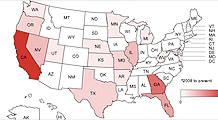

NEW YORK (CNNMoney.com) -- Bank regulators closed a Georgia-based bank Friday, marking the 21st bank to be shuttered this year, according to a statement from the FDIC.
Earlier in the afternoon, the Office of the Comptroller of the Currency (OCC) announced that the Federal Deposit Insurance Corporation (FDIC) was named the receiver for the Omni National Bank, based out of Atlanta, Ga.
The FDIC entered into an agreement with the SunTrust Bank, also based in Atlanta, Ga. to protect the depositors.
The FDIC expects the cost to its Deposit Insurance Fund to be $290 million.
The failed Omni National Bank had $956 million and total deposits of $796.8 million as of March 9, 2009, according to the FDIC.
Omni National Bank, founded in 2000, had six full service branches located in Atlanta and Dalton, Ga.; Chicago, Ill.; Tampa, Fla; and Houston and Dallas, Texas.
SunTrust Bank (STI, Fortune 500) will operate the six former branches of Omni National through April 27, 2009. During the month-long transition period, banking activities will operate normally.
At the end of the 30 days, all the branches of the failed bank will close. Depositors in Georgia and Florida can open an account with SunTrust or terminate their account and receive a check, according to the FDIC. Customers of those branches will automatically be transferred to SunTrust if they do not make a decision otherwise.
Meanwhile, customers of the failed bank branches in Illinois or Texas who have not closed their accounts will automatically get a check mailed to them.
According to the FDIC, the temporary arrangement with SunTrust bank allows for uninterrupted service with direct deposits and gives customers a cushion of time to find a new bank.
The FDIC fully insures individual accounts up to $250,000 through the end of 2009. At the time of the Omni National Bank closing, however, there were around $2 million in deposits that potentially exceeded the insurance limits, according to the FDIC, although those estimates will likely change as further information comes in from customers.
Brokered accounts are considered separately. The FDIC will pay the $320.1 million in brokered deposits directly to the brokers for the total of their insured funds.
The failed bank also had two loan production offices, one located in Birmingham, Ala. and another in Philadelphia, Pa.
Federal regulators said they took control of Omni after the OCC found "the bank had experienced substantial dissipation of assets and earnings due to unsafe and unsound practices." The OCC also found that the bank has "depleted most of its capital," and that it couldn't "become adequately capitalized without Federal assistance."
So far in 2009, 21 banks have been shuttered. Last week, three banks were closed.
Twenty five banks failed in 2008, crippled in the wake of the housing meltdown. Plummeting home prices rendered a slew of subprime mortgages nearly worthless. As the recession took hold, unemployment surged, and default rates on loans - for homes, autos, and on credit cards - increased, further squeezing banks.
Plagued with toxic assets on their books and increasing default rates, banks started hoarding cash. With banks scared to lend money, credit pipelines virtually dried up, which only served to accelerate the rate at which the economy fell into recession.
On Monday, Treasury Secretary Timothy unveiled details of his plan to take those toxic assets off the balance sheets of banks, giving them the confidence to lend again. Geithner alluded to the plan in broad strokes last month, but investors were skeptical until they heard more specifics about the plan.
Under the new so-called "Public-Private Investment Program," taxpayer funds will be used with private investors cash to buy up toxic assets backed by mortgages and other loans. The goal of the plan is to cover at least $500 billion of assets and loans.
The FDIC has been charged with the task of overseeing the toxic-asset plan that Geithner introduced. The FDIC has already been hit hard by the increase in bank failures, and the increased rate of failures has put pressure on the FDIC's funds.
Talkback: Do you have health insurance? Are you satisfied with your coverage? If you do not have health insurance, how do you pay for health care? E-mail your story to realstories@cnnmoney.com and you could be part of an upcoming article. For the CNNMoney.com Comment Policy, click here.