
America's oil bust
Falling oil prices and frozen credit are slowing production and piling up equipment. Now some worry we're setting ourselves up for another price spike.



 |
| Willard Cline has run the Cline Oil Co. since 1946. He says low prices have shut in about half his daily production. |
 |
| Shawn Keane, in front of idled oil field service rigs. Keane has laid off about a third of his employees as low prices curtail production. |
 |
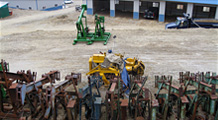
| Waiting for higher prices: Oil equipment lines a dirt road in Western Pennsylvania. |
 |
| Oil jacks, usually in the field, sit behind Cline's shop. |
BRADFORD, Pa.�(CNNMoney.com) -- Six months ago this oil town in Western Pennsylvania was booming. You couldn't find a worker to paint a house, let alone man a drill rig. The nearby oil fields buzzed with activity as high prices drove a production frenzy.
Now this boomtown's bustle is as quiet as the surrounding late-winter forest.
The collapse in oil prices from over $147 a barrel has caused many oil producers to pack up their rigs and stow their jacks. Some fear the drop in production activity will lead energy prices to spike once the economy recovers.
"We're not drilling right now," said Willard Cline, who has run the small Cline Oil Company since 1946. "The low price of oil is slowing it up."
In these hills a few hours north of Pittsburgh, where John. D. Rockefeller got started more than a century ago, oil equipment lies idle in hay fields and along dirt roads.
Cline estimates about half his daily production is shut in.
Drillers and oil service firms are also pulling back.
Just outside Bradford, Pa., Keane and Sons Drilling Corp. recently laid off 20 employees - about a third of its workforce.
Half the company's drill rigs sit at the shop. A row of brand new fracing trucks, used to inject fluids into oil wells to get production flowing, line the back of the parking lot.
"Once oil dropped below $75 a barrel, the economics just don't make sense for the wells we have around here," said Shawn Keane, who now runs the company along with his brother. "Just about everyone we've talked to is in the same situation we are."
The pullback isn't limited to Pennsylvania. From Texas to Wyoming to California, places once considered boomtowns are now going bust as energy prices drop and access to credit dries up.
Nationwide, the number of drill rigs fell almost 50% since October, the steepest decline since the energy bust of the mid-1980s. Worldwide production numbers have been continuously revised down nearly every month since late last year.
"It's like things fell off a cliff," said Richard Mason, publisher of the Land Rig Newsletter, an industry paper that tracks oil and gas rigs in the U.S. If it continues, Mason said production could be hurt permanently.
Back when oil prices were over $100 a barrel, one of the reasons given for the price spike was that the oil industry, having suffered through years of low prices in the 1980s and 1990s, simply didn't have enough equipment and manpower to bring more supplies to market. With oil prices high, the industry invested rapidly and the world saw an up tick in production.
Now, with prices far below $100 and investments falling, we could be setting ourselves up for another price spike once the economy recovers.
"Supply may be an issue," said Peter Tertzakian, chief energy economist at ARC Financial, a Calgary-based private equity firm. "Just at a time when demand is coming back we may wake up and find we haven't invested enough."
Tertzakian, like most oil analysts, doesn't think a spike in price is a foregone conclusion. OPEC has taken a lot of supply off the market already, and rigs in the U.S. could be brought back online in a year or so. It really all depends on how fast the economy recovers, and if oil prices rise gradually over that time period to encourage an incremental rise in investments.
Others point out that while the number of oil rigs is way down in the U.S., many of those rigs were either producing just small amounts of oil or were very expensive to run.
"People were putting up rigs left and right at prices that didn't really make sense," said Ruchir Kadakia, a global oil analyst with the consultancy Cambridge Energy Research Associates.
But the specter of a price spike, combined with the pain fluctuating energy prices inflict, raises the question: Isn't there anything that can be done to smooth out these peaks and troughs?
The boom and bust cycle has dogged the oil industry since the days of Rockefeller. Almost no one likes it - oil companies don't know how many people to hire, consumers don't know what size car to buy and businesses don't know their long term energy costs. Imagine how hard it would be for you if your paycheck fluctuated by up to 70% every five months.
Even after 150 years of this roller coaster, we're still far from implementing a better system to price this essential commodity.
An easy answer, and one often brought up in casual conversation, is some type of price control. The government would say oil prices can't go below $50 or above $100, or some such number. Oil companies would have a guaranteed minimum price, and consumers would have a guaranteed maximum price. Everyone wins.
But hardly anyone in the industry thinks this would work.
"That's a great idea, if the government knew what the right price was," said Doug MacIntyre, an oil market analyst at the government's Energy Information Administration.
The thinking is that millions of people operating in a free market are much better at setting an efficient price than a handful of people in Washington - something most people with experience in a centrally planned economy can attest to.
The government, it is feared, would either set the price too high and encourage a wasteful surplus, or set it too low and cause a shortage.
"It's almost a given the government would set an inefficient price level," said McIntyre.
A better alternative, experts say, is to encourage long term, stable policies that focus on both increasing supply and shrinking demand.
On the supply side, encouraging greater access to resources and a stable tax policy that gives breaks for oil production is what the oil industry is looking for.
On the demand side, stricter fuel efficiency standards, better urban planning, alternative fuels and a big tax on gasoline would help cut use.
"We've never had a real, long-term strategy to address the energy problem," said Bruce Vincent, vice chairman of the Independent Petroleum Association of American, an industry trade group. "We need to have a comprehensive strategy that works for America."
Absent more aggressive policies dealing with both our supply and demand, the people in Western Pennsylvania who have worked in this industry for decades know exactly what will happen once the economy recovers.
"We'll be short of fuel," said Cline. "The price will skyrocket." 



