
What cutting $100 million really means
Obama directed his cabinet to cut $100 million in spending. That's a start. But it won't move the needle on the country's real budget problem.



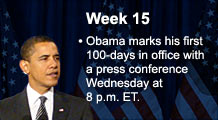
NEW YORK (CNNMoney.com) -- President Obama told his Cabinet on Monday to come up with ways to collectively cut $100 million from their agencies' budgets.
Call it a slow start to curbing Uncle Sam's spending.
In essence the president has asked government agencies to trim the equivalent of .003% of the federal budget. Looked at another way, $100 million is .006% of this year's estimated budget deficit.
"It's more symbolic of the president's promise to find and eliminate wasteful spending," said Charles Konigsberg, an expert on the federal budget at deficit watchdog group the Concord Coalition.
The $100 million in trims are not Obama's only promised spending cuts. He also said Monday that his administration will in the next few weeks propose eliminating more than 100 federal programs. The money saved would be put toward his proposed initiatives in health care, education and energy, Obama said.
And those savings would come on top of more than the roughly $92 million in annual savings over the next five years and the nearly $24 million in one-time savings that agencies have already identified.
Even adding all that up, however, the country will remain a very long way from fiscal balance indefinitely.
One reason the cuts pale compared to the problem: Even fiscal hawks are not recommending the government seriously curb its spending in the midst of the steep economic downturn.
But the bigger reason is that all such cuts would come can't make a dent in what's upending the country's chance at long-term fiscal balance: the rising costs related to Medicare and Medicaid primarily, and secondarily, to Social Security.
Barring changes, come 2030 the cost of Medicare, Medicaid, Social Security and the interest the country owes on its debt will consume all the annual tax revenue the government collects, Konigsberg said.
"It's always good to look for wasteful spending to be eliminated," he said of the $100 million in savings the president has called for. "But it's important it not become a distraction" to dealing with the 800-pound gorilla in the room.
"This requires addressing the unsustainable growth of entitlements and the erosion of the tax base," Konigsberg said.
The administration has proposed in its 2010 budget request that Congress create a $634 billion health care reform reserve fund. The White House said the fund represents a "down payment" on health care reform so the growth of costs can be slowed over time.
For his part, the president acknowledged that the cuts he called for were hardly a fiscal panacea.
"None of these things alone are going to make a difference. But cumulatively they would make an extraordinary difference because they start setting a tone," Obama said. "And so what we're going to do is line by line, page by page, $100 million there, $100 million here, pretty soon, even in Washington, it adds up to real money." 



