
Stocks: I love the 70s? Or the 80s?
This explosive stock market rally reminds some of the bear market blips from the mid-1970s. But others think it's the beginning of a new bull like 1982. Who's right?




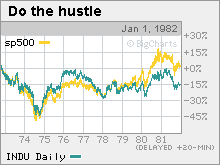 |
| Stocks enjoyed a strong pop in 1975 and 1976. But that didn't usher in a new bull market. |
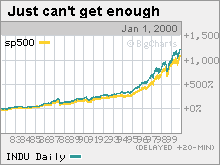 |
| The bull market actually begain in 1982. The next 18 years were a period of relatively little market turmoil as stocks soared to new highs. |

NEW YORK (CNNMoney.com) -- Disco or new wave? "Jaws" or "E.T.?" Reggie Jackson on the Oakland A's or California Angels? 1975 or 1982?
With the stock market in the midst of a massive two-month rally -- 35% since the March lows -- investors are wondering if this is going to be just a blip in a long bear market (like 1975) or the start of a new bull run (like 1982).
Of course, it's impossible to know at this point, and several savvy investing veterans are split on whether this rally is for real.
Barry Ritholtz, CEO and director of equity research at research firm Fusion IQ, isn't convinced the worst is over. He pointed out how after two terrible years for stocks in 1973 and 1974, the markets roared back in 1975 and 1976 -- only to fall again in 1977 and 1978 and be choppy right up until about 1982.
Ritholtz said that what's happening now has more similarities to the mid-1970s than the early 1980s.
One concern is that stocks just aren't that cheap.
The trailing price-to-earnings ratio for the S&P 500, which is calculated using actual earnings and not estimates, is currently about 13. That's closer to where it was in the mid-1970s (around 12) as opposed to the single-digit P/E for the index at the start of the 1982 bull market, Ritholtz said.
"When you look at the conditions that typically accompany the beginning of bull markets, you have stocks being hated. It's rare to see new bull markets when stocks are fairly valued as opposed to dirt cheap," Ritholtz said.
Jeffrey Saut, chief investment strategist for Raymond James & Associates in St. Petersburg, Fla., agreed that it's tough to say the bear market is over since stocks still aren't historically cheap.
"I don't know if it's a new bull market. I'd like to think it is. But the beginning of every bull market comes from valuations cheaper than where we are here," Saut said.
Both Ritholtz and Saut both agreed that another strike against a lasting rally is that a lot of speculative stocks have led it.
"There is a lot of speculation. This rally has been led by junk, dollar stocks like Citigroup (C, Fortune 500), Bank of America (BAC, Fortune 500) and Ambac (ABK)," Ritholtz said, referring to two of the most beaten down banks and the troubled bond insurer. Ritholtz said he'd want to see more stable companies start leading the really before declaring that the bear is gone for good.
Still, not everybody thinks the bear is coming back. Phil Dow, director of equity strategy for RBC Capital Markets in Minneapolis, thinks that the current rally is more like the one in 1982.
Back then, the United States was emerging from a painful double-dip recession and rallied on signs that the economy was improving. Dow said that this is usually how recoveries start: stocks tend to rally sharply before it's clear the recession is over.
"This rally has all the earmarks of better times ahead for stocks for the long-term," he said. "If the market has done this on just "less bad" numbers, then when we get real improvement in corporate earnings and the economy, stocks can still head higher."
Alan Skrainka, chief market strategist with Edward Jones in St. Louis, added that even though the problems facing the economy in the 1980s were vastly different than now, he thinks that there is one important similarity: the government has taken, bold aggressive steps to tackle the crisis.
Skrainka pointed out that interest rate hikes under former Federal Reserve chairman Paul Volcker and subsequent tax cuts during the Reagan administration, helped curb the hyperinflation of the 1970s and set the stage for the bull market.
This time around, fiscal stimulus from the Obama administration and a litany of programs launched by the Fed and Treasury Department to try and fix the nation's broken banking system appear to be helping to restore confidence in banks and the broader economy.
"This isn't comparable to the Great Depression," Skrainka said.
Dow added that the longer the rally lasts, the harder it will be for the momentum to be derailed. As such, improving stock prices could lead to a pickup in merger activity, which could fuel even more market gains. And an M&A boom was a hallmark of the 1980s and 1990s.
So who's right?
I'm worried that the market may be getting ahead of itself in the short-term. It's also still far from certain if the government's actions during the past few months will really fix the economy. And if even this medicine does work, the Fed could eventually have to worry about an economy that's too robust.
"The amount of stimulation by the government will force the Fed to begin raising rates and stifle inflation," said John Lekas, principal with Leader Capital Corp., a money manager in Portland, Ore.
But there are also some encouraging signs that could set the stage for a longer-term, sustainable rebound in the economy. So it may not be wise to bet against the market at this point.
At the very least, it's probably a good idea to wade back in to stocks as long as you're willing and able to hang on to your investments for several years. In other words, keep those KC and the Sunshine Band records in storage.
"Too many people may have bought into the argument that a buy and hold strategy is dead," said Dow. "But there are more opportunities to get caught flat-footed by not being invested." 



