States: It's taxes, taxes and more taxes
Desperate to balance budgets, states are hiking income and sales taxes on people and businesses.



NEW YORK (CNNMoney.com) -- Facing mounting budget deficits and seeing few areas left to cut spending, states increasingly are turning to the only option they have left: raising taxes.
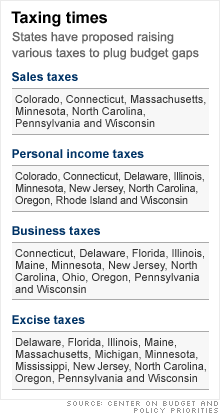
Though public officials are loath to do this, particularly during a recession, many governors are increasing personal income taxes, raising corporate income taxes, hiking cigarette and gas taxes, or broadening sales taxes.
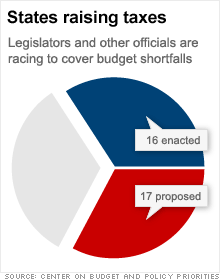
Already, 16 states have taken this unpopular step this fiscal year, and another 17 have proposed tax hikes for the coming year, according to the Center on Budget and Policy Priorities, a policy group. In many cases, they are making small increases in specific taxes, rather than imposing a broad rate hike.
"The question isn't whether to raise taxes, it's which taxes to raise," said Linda Bilmes, professor of public finance at Harvard's Kennedy School of Government.
Wealthier residents in Hawaii are now paying higher personal income taxes. The state increased the tax rate to 11% for single filers earning more than $200,000 and couples making more than $400,000, while also raising levies on hotel accommodations and real estate purchases.
Smokers in Rhode Island, meanwhile, now pay the highest state tobacco taxes in the nation, forking over an additional $1 for a total of $3.46 in state levies per pack.
California, where voters Tuesday defeated several budget measures, has already increased sales taxes by one percentage point and state income taxes by a quarter point. Now, Gov. Arnold Schwarzenegger says he has to make even deeper cuts to the state budget to close a $21.3 billion shortfall.
States are looking at budget shortfalls exceeding $350 billion over the next two and a-half years, according to the Center on Budget and Policy Priorities. While federal stimulus money is expected to close about 40% of the gaps, governors will have to take additional steps, which likely will include more spending cuts and tax increases.
"There's really no way to balance the budget in a reasonable way without looking at the tax side," said Nick Johnson, director of the center's state fiscal project. "These states are looking for balanced solutions that aren't all about cuts, cuts, cuts."
In one of the more extreme measures, Illinois Gov. Pat Quinn has proposed a 50% increase in state personal income and corporate taxes. He's struggling to close a nearly $11.6 billion budget gap for fiscal 2010.
The governor wants to increase the personal income tax rate to 4.5%, up from the current 3%, and the corporate tax rate to 7.2%, up from 4.8% now. To offset some of the spike, the personal exemption would triple to $6,000.
The hike would bring in an additional $2.8 billion in personal income tax revenue and $350 million in corporate taxes.
Without this revenue, Illinois might have to let out 6,000 prisoners early and lay off half the state troopers, among other spending cuts, said Quinn, who took office in January after former Gov. Rod Blagojevich was removed.
"If we don't use the public revenue of Illinois to help rescue our state economy, we're going to continue in hard times," Quinn said in a speech Monday. "It will take a significant toll on the people of Illinois if we don't raise the revenue ... to pay the bills, to make sure our state no longer has a deficit of nearly $12 billion."
After enacting several tax increases affecting mainly corporations earlier this year, Wisconsin Gov. Jim Doyle is now turning to the residents. Facing a $6.6 billion gap for the 2010-2011 budget, the governor has proposed a one percentage point increase in the tax rate of individuals earning more than $225,000 and couples earning more than $300,000. The highest rate would grow to 7.75%, bringing in an estimated $312 million over the life of the two-year budget.
Also, Doyle wants to decrease the amount of capital gains excluded from tax to 40%, down from 60%, which would bring in nearly $181 million.
Finally, the governor proposed increasing the state's cigarette tax by 75 cents to $2.52 a pack. This would boost state revenue by $291 million.
In February, Doyle enacted several measures, including increasing taxes on companies with multistate operations and requiring buyers of business software to pay sales taxes. These measures are expected to bring in more than $280 million, according to David Schmiedicke, the state's budget director.
Even with all these tax increases, the state will still have to make $2.2 billion in cuts over the next two years. Without them, the pullback would be even worse.
"If not for these targeted revenue increases, the cuts would have to be much deeper to schools, to our university system and to funding for our local police and fire departments," Schmiedicke said.
Raising taxes during a recession is nothing new, though states usually strive to balance budgets by cutting spending first.
During the recession of the early 1990s, 44 states raised taxes, adding more than $25 billion to the coffers between 1990 and 1993, according to the Center on Budget and Policy Priorities. Some 26 states increased personal or corporate income taxes, while 37 raised sales or excise taxes.
Earlier this decade, some 30 states raised taxes, increasing revenue by $18.6 billion between 2001 and 2004, the center found. Ten raised personal income taxes, while 16 lifted levies on businesses. Some 16 increased either the sales tax rate or broadened the base of services and goods covered by it. And 29 raised excise taxes on cigarettes and alcohol.
More tax increases are likely as states continue to struggle with the economic downturn, especially since state revenues usually don't recover until 12 to 18 months after the national economy turns around.
"Based on the severity of this recession, the tax measures could get larger, more expensive and more extensive," Johnson said.