
Sell in June, watch stocks swoon?
If you sold in May and went away, you'd have missed out on more decent gains for stocks. It just goes to show that trying to time the market is a silly idea.




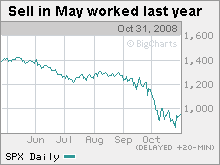 |
| Stocks plunged in the summer of 2008. But it was because of the collpase of the credit markets, not because of seasonal factors. |
NEW YORK (CNNMoney.com) -- Wall Street traders have a lot of funny ways to try and predict stock performance.
There's the hemline indicator, which tries to equate fashion trends to stocks. According to that maxim, the shorter women's skirts are, the better stocks should do. It's also known as the bull market, bare knees phenomenon. Classy.
Then there's the Super Bowl indicator. Stocks are supposed to go up in a year when an "old" NFL team wins the Vince Lombardi Trophy. Sadly, that didn't work out too well when my New York Giants improbably beat the New England Patriots last year.
But the aphorism that is perhaps the most amusing is "Sell in May and go away."
This is based on the belief that stocks won't perform well during the six months stretching from May through October and that a better time to be invested is from November through April.
In other words, it's an excuse for market professionals to take the summer months off and head to the beach.
But is that really a good idea? Should people really try and trade the market based on what it says on the calendar as opposed to factors such as corporate earnings, economic data and stock valuations? Of course not.
Anyone that has used that strategy this year has missed out on some decent gains in May.
Stocks finished Friday, the last trading day of May, higher. For the month, the Nasdaq rose 3.3%. The Dow gained 4% and the S&P 500 was up more than 5%
What's more, several widely-held blue chip stocks in a variety of sectors have soared. Walt Disney (DIS, Fortune 500), for example, gained nearly 10% in May. Shares of Boeing (BA, Fortune 500) were up about 12%. And bank stocks have continued to rebound: Citigroup (C, Fortune 500) and Bank of America (BAC, Fortune 500) each have gained more than 20%.
Talkback: How do you think stocks will do this summer? Leave your comments at the bottom of this story.
Obviously, this doesn't mean that stocks are definitely going to continue rallying through the summer. It could very well turn out that the market finally has the type of correction that many have been calling for now that the S&P 500 is up nearly 35% since March.
It is also true that stocks have occasionally not performed as well in the summer as they do in the earlier and latter parts of the year. And there are some logical reasons for that, especially the typical market gains in November through February.
Consumers tend to hit the malls more frequently in the fourth quarter because of holiday shopping. Businesses often have fourth-quarter "budget flushes" that require them to boost spending before the end of the year. And investors begin to anticipate healthy fourth-quarter results, which most companies report in January and February, a few months ahead of that.
Still, it's not as if the summer doldrums are times when stocks always do poorly. In fact, a look at how stocks have done in May through October during the past few years shows that "going away" in the summer is a bad idea.
Yes, last summer was one to forget. It would have been nice to have missed out on the collapses of Fannie Mae (FNM, Fortune 500), Freddie Mac (FRE, Fortune 500), IndyMac, Lehman Brothers, AIG (AIG, Fortune 500) and WaMu. Whew! The S&P 500 plunged 30% from May through October as the credit crisis paralyzed the markets.
But the summers of 2006 and 2007 were good times to stay invested in stocks. The S&P 500 rose about 5% from May through October in each of those years. What's more, this benchmark index was up a bit in the summers of 2004 and 2005. And it shot up nearly 15% in the summer of 2003!
Now this shouldn't be a shock to anyone who was investing during those times since the overall market was up every year during that five-year stretch. Unsurprisingly, the sell in May strategy did actually work during the last bear market: the S&P 500 fell during May-October of 2000, 2001 and 2002.
What's this all mean? Trying to time the market is a pointless exercise. Stocks tend to do well in periods of economic growth and when investors are anticipating a recovery. And stocks usually are lousy bets when the economy is sluggish and earnings are weak.
So what happens next for stocks is going to depend more on whether the worst really is over for the housing market and banks and how much of an impact the inevitable bankruptcy filing of General Motors (GM, Fortune 500) has on the economy -- not the fact that the days are getting longer and the temperature is starting to rise.
But for what it's worth, I'm seeing a lot of women wearing mini-skirts on the subway and the Pittsburgh Steelers won the Super Bowl this year. So I guess this rally is for real after all.
Talkback: How do you think stocks will do this summer? 



