
Upstarts ready to rule world's economy
A research firm predicts the West's share of the global economy will be eclipsed by emerging markets this year. No wonder Tim Geithner's in China.




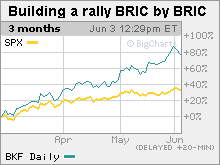 |
| The S&P 500 has soared on U.S. recovery hopes during the past three months. But an index tracking emerging markets Brazil, India, Russia and China (BKF) has done even better. |
NEW YORK (CNNMoney.com) -- It's only fitting that General Motors, once the embodiment of U.S. economic might, decided to sell its Hummer brand to a Chinese manufacturer after GM (GMGMQ) filed for bankruptcy.
We may not like to admit it, but it's time to get used to this fact: emerging markets such as China and India are quickly becoming the world's new economic powerhouses.
In fact, according to a report from a leading economic research group released earlier this week, emerging market economies may overtake the U.S. and the rest of the Western world this year.
The Centre for Economics and Business Research (CEBR), a London-based economic consulting firm, predicted that the United States, Canada and Europe will contribute 49.4% to the world's total gross domestic product in 2009.
According to the CEBR, this will be the first time since the beginning of the Industrial Revolution in the mid-19th century that non-Western economies produced more than half of the world's GDP.
The CEBR said it had originally predicted emerging markets would make up a bigger portion of the world's economy than the West -- but not until 2015. The firm said the resurgence of China's economy is the main reason why it expects the West's share of global GDP to dip below 50% this year.
"We had expected this to happen, but not quite so soon. The West will have to start to get to grips with the fact that we are no longer dominant and cannot expect to have things our own way," said Douglas McWilliams, chief executive of CEBR, in a statement.
Now the United States is still the world's economic leader. If the global economy were a basketball team, the U.S. is Kobe Bryant. But China is LeBron James (sorry, Cavs fans). In other words, China isn't the champ yet, but it's catching up fast.
Along those lines, CEBR forecast that China will surpass Japan this year as the world's second largest economy. China is already the largest holder of U.S. Treasury notes and the country's second biggest trading partner.
Those are key reasons why Treasury Secretary Tim Geithner is in China this week: he's trying to make nice with our largest creditor and a key market for exports. It's smart to do so.
Talkback: Are you concerned by the increased economic clout of China, India and other emerging markets? Leave your comments at the bottom of this story.
After Chinese leaders expressed concerns earlier this year about how much debt the U.S. government is incurring to bail out financial firms and stimulate the economy, it's important to convince China that the dollar is not going to be devalued into oblivion and that Treasurys will remain safe investments.
"China is now the largest of the U.S. creditors and its willingness to absorb U.S. Treasurys could be key to the success of the U.S. fiscal stimulus and banking sector rescues," wrote analysts for RGE Monitor, the economic research firm run by NYU Stern economics professor Nouriel Roubini, this week. "No wonder Treasury Secretary Geithner faced questions about the U.S. fiscal deficit reduction plan in Beijing."
This doesn't necessarily mean that the United States is doomed to a massive economic fall from grace. In fact, it does not appear to be a coincidence that hopes of a U.S. economic recovery have helped lead a surge in stocks in China, India, Latin America and other emerging markets.
According to mutual fund research firm Morningstar, emerging markets funds have actually outperformed the broader U.S. market since the rally began in March.
Latin American stock funds, for example, are up a staggering 78% in the past three months, while Pacific/Asia funds (excluding Japan) are up 66%. The S&P 500, by way of comparison, is up about 35% during the same period.
If nothing else, both the reaction to a potential U.S. recovery and the fallout from the problems in the U.S. housing and credit markets should prove beyond any shadow of a doubt that the notion of economic decoupling was a myth.
America led the rest of the West into recession, as many European banks had massive exposure to bad mortgage loans in the United States. The credit crisis wound up contributing to a slowdown for China and other emerging markets. China's economy grew at its lowest level in nearly two decades during the first quarter.
And now that the United States is showing some signs of economic stabilization, emerging markets have snapped back.
So rather than bemoaning the West's inevitable slip in economic importance, investors need to embrace emerging markets and realize that interdependence is key to the global economy.
"China and other emerging markets have tied themselves intricately to the U.S. economic system," said James Swanson, chief investment strategist with MFS Investment Management in Boston. "As the U.S. recovers, that means that there will be a lot of earnings growth coming out of China and other emerging markets like India and Brazil."
With that in mind, Swanson said investors need to be thinking more about buying shares of multinational U.S. construction firms that will benefit from increased demand in emerging markets, as well as mining, energy and manufacturing companies in China, India and Brazil.
So if companies such as Alcoa (AA, Fortune 500), Ford Motor (F, Fortune 500) and ExxonMobil (XOM, Fortune 500) are in your portfolio, you might also want to take a look at Aluminum Corp. of China (ACH), India's Tata Motors (TTM) and Brazil's Petrobras (PBR) as well.
"U.S. investors can't have 80% to 90% of their portfolio in the U.S. anymore," Swanson said. "The old notion of having 5% to 10% in international stocks is outdated. Americans should increase their weight in emerging markets."
Talkback: Are you concerned by the increased economic clout of China, India and other emerging markets? 



