

States propose $24 billion in tax hikes
Massive revenue declines force states to hike taxes and fees to balance fiscal 2010 budgets. California accounts for $11.3 billion of the increase.



NEW YORK (CNNMoney.com) -- States are poised to pass as much as $24 billion in tax and fee hikes in coming weeks, as they struggle to balance their budgets amid the worst economic downturn since the Great Depression, a report released Thursday found.
The spike blows away the $726 million in recommended increases for fiscal 2009.
At the same time, state budgets are set to shrink for a record second year in a row. The recession has caused tax collections to plummet and the need for social services to soar.
State officials are scrambling to close last-minute budget gaps that opened after April tax revenues came in below already-lowered estimates. States may be forced to tap rainy day funds or impose even more stringent spending cuts to balance their budgets before their fiscal years end on June 30.
Governors' proposed budgets for fiscal year 2010 show a 2.5% decrease in general fund spending, which comes after an estimated 2.2% decline in the current fiscal year. State spending usually rises 6% a year.
This is the largest pullback in the survey's 30-year history and the first time state spending would decline for two years in a row, according to the National Governors Association and the National Association of State Budget Officers.
Also, in an unusual turn, the recession is hammering nearly all states across the country.
"These are some of the worst numbers we've ever seen," said Scott Pattison, executive director of the budget officers group.
General fund spending, which is not earmarked for specific uses, covers mainly education, Medicaid, corrections, public assistance and transportation.
Some 29 states are recommending tax and fee increases for the coming fiscal year.
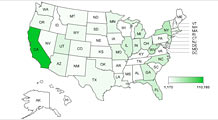
California, which is struggling to close a $21.3 billion budget gap, accounts for $11.3 billion of the hike. Illinois makes up another $4.4 billion, while New York is proposing $4 billion in additional levies.
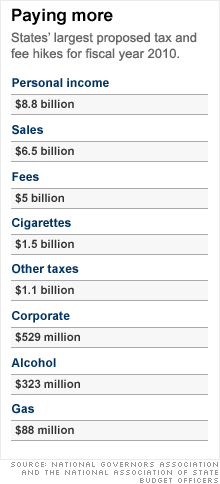
Hikes in personal income taxes account for $8.8 billion, while sales taxes are set to rise $6.5 billion. Higher cigarette taxes would bring in $1.5 billion, while corporate taxes would rise $539 million.
State officials are searching for ways to boost revenue at a time when tax collections are falling off a cliff. Corporate income tax revenue is expected to be down 15.2%, personal income down 6.6% and sales tax down 3.2%.
Though state officials are reluctant to raise taxes during a recession, they have little choice these days.
"If you look historically, we've seen numbers at times of $14 or $15 billion, but never a number of that order or magnitude," said Raymond Scheppach, head of the governors' group, referring to the proposed $24 billion in tax hikes. "As we go along, governors are going to continue to want to cut budgets, but they are going to be forced to look more and more unfortunately on the revenue side."
States also are dipping into their rainy day funds to pay the bills. The funds' balances totaled 9.1% of expenditures in fiscal 2008, but have declined to 5.5% in the current year. However, excluding Texas and Alaska, the funds' balances dip to 3.6% of expenditures. A balance of 5% of expenditures is considered a relatively adequate cushion.
This downturn is likely to damage state's financial health more seriously than other recessions in recent years because it is deeper and will last longer, said Scheppach. The last really bad year for states was 1983, when budgets shrank 0.7%, but it was preceded and followed by strong periods. This recession will likely plague states for up to three more years.
"There's no capability to build the revenue base, build the rainy day fund," he said. "You are really on the defensive the entire time."
Though demand for state services is up, officials are slashing spending on a wide range of government programs.
Some 28 states have proposed cutting spending on higher education and personnel, while 27 want to reduce funding for K-12 education. Another 25 states have proposed cuts to Medicaid and corrections, while 23 are reducing funds for public assistance.
A record 42 states had to cut their fiscal 2009 budgets in the middle of the year as revenue came in below estimates.
Even worse, 20 states still have budget gaps they must close before the end of the fiscal year.
State officials predict tight times through fiscal 2011 and possibly 2012 since state fiscal recovery historically lags a national economic rebound.
They are currently facing an estimated $230 billion in budget gaps between fiscal 2009 and fiscal 2011. 



