
Cost of rescues: $835 billion this year
Congressional Budget Office estimates 2009 outlays to stem economic and financial crises. But the bigger problem for the budget looms elsewhere.



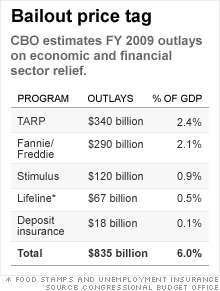
NEW YORK (CNNMoney.com) -- The federal government is likely to spend $835 billion this year fighting the crises in the financial system and the economy, according to a new report by the Congressional Budget Office.
That spending represents about 6% of the nation's gross domestic product.
Of that amount, $340 billion is going toward the Troubled Asset Relief Program, which is being used primarily to bail out banks, insurers and the auto industry. Another $290 billion in 2009 outlays is being used to prop up mortgage giants Fannie Mae (FNM, Fortune 500) and Freddie Mac (FRE, Fortune 500).
In addition, $187 billion is being used for economic stimulus and relief efforts such as extended unemployment insurance.
As expensive as that seems, the CBO notes that "the current recession has little effect on long-term projections of non-interest spending and revenues."
Not that the country won't see whopping deficits as a result of the crises that have unfolded in the past year. In fiscal years 2009 and 2010, Uncle Sam will rack up the largest annual deficits as a share of GDP since World War II.
And those annual deficits will, of course, exacerbate the total debt the country has accumulated over time. The agency estimates that federal debt will reach 60% of GDP by the end of fiscal year 2010. That's well above the 41% recorded for 2008.
But over the long-term, CBO said, much greater pressure will bear down on the federal budget -- raising "fundamental questions about economic sustainability." That's because, barring any changes, federal debt is on track to greatly outpace economic growth over time.
The main culprits are the growth in federal spending on Medicare and Medicaid and, to a much lesser degree, Social Security. The growth rate in spending on those entitlement programs is due to two factors: the growth rate in health care spending and an increasing number of Americans growing old.
Today roughly 5% of GDP is spent on Medicare and Medicaid. By 2035, the CBO estimates, that number will double. The jump in Social Security spending is projected to rise from under 5% of GDP today to 6% by 2035.
The government faces no easy choices in trying to rectify the fiscal problems. CBO notes that if spending continued to grow as expected -- and lawmakers raised tax rates to compensate -- "tax rates would have to reach levels never seen in the United States."
That, in turn, would seriously compromise the prospects for economic growth and make it harder to repay debt.
And on it goes.
Addressing the situation would require a combination of tax increases, spending cuts and a slowing in the growth rate of health care costs. The longer lawmakers wait, the more painful and sudden the solution will need to be.
Congress is addressing health care reform. That is likely to cost another trillion or so, but it's a cost President Obama has insisted be paid for.
He has also called on Congress to reinstate what's called "statutory pay-go" -- which would legally require lawmakers to pay for any new programs they propose without borrowing money.
But pay-go wouldn't be enough to get the federal budget onto a sustainable path, said former CBO Director Alice Rivlin, a senior fellow at the Brookings Institution.
"The biggest threat to future budget solvency is not new legislation. It is the budgetary consequences of legislative decisions already made -- both with respect to mandatory spending and the tax code," Rivlin said in written testimony for the House Budget Committee on Thursday.
The Concord Coalition, a deficit watchdog, echoes that call, noting that pay-go is meant to stabilize the deficit rather than reduce it. And lawmakers are still allowed to exempt certain measures from pay-go -- meaning they can decide a new expensive program or tax cut need not be paid for. 



