
Out of work, out of benefits, out of luck
By August, 65% of all filers for unemployment insurance will have run out of their standard 26 weeks. And that's just the beginning.




NEW YORK (CNNMoney.com) -- The next bubble in the recession is about to burst.
More than 650,000 Americans will have used up all of their unemployment benefits by September, in what experts say could be the start of a looming crisis.
In the early days of the downturn, the government extended unemployment benefits beyond the standard 26 weeks to as many as 79 weeks in hopes of giving the jobless a longer lifeline. Officials predicted the economy worsening and businesses further contracting, resulting in fewer jobs for the newly unemployed to find.
With the recession now 18 months deep and the national unemployment rate standing at 9.5%, it appears that the effort wasn't robust enough for those in the crisis' first wave of layoffs.
"We need to get the issue attention now, because people are running out of benefits and there's just nothing for them," said Andrew Stettner, deputy director of the National Employment Law Project, an advocacy group that has calculated the number of people who will exhaust their unemployment benefits.
In fact, Stettner and the Labor Department are expecting the problem to accelerate. In the next few weeks, the victims of the mass layoffs that happened six months ago -- when the pace of layoffs was at its zenith -- will start running out of their basic benefits. A total of 4.4 million people are expected to face this fate -- or 65% of the entire filing population.
And while they may have up to another year of unemployment insurance benefits -- thanks to the confusing patchwork of extensions that were enacted last summer -- they will be soon be unaccounted for in government unemployment reports.
The Labor Department doesn't track anyone who has moved beyond 26 weeks of unemployment in its weekly data on continuing claims (the number of people who request benefits after their first week). And, said Stella Cromartie, spokeswoman for the Bureau of Labor Statistics, said the agency does not currently have plans to begin tracking this population.
As a result, by late summer the government may begin reporting significant declines in continuing filers. But it won't be cause for celebration. Instead of of indicating that the economy is on the rebound, it could mean that more people are falling off the radar.
"We will see a decline in continuing filers," said the NELP's Stettner. "People are falling out of these numbers, and the pace of more recent layoffs replacing them is not as steep."
"They're not included in these unemployment numbers we hear about every week," said the NELP's Stettner. "They're desperate, asking, 'What's going to happen to me?'"
That's the question facing Jay Ridinger, 54, of Baxter, Tenn. The self-proclaimed "road warrior" once worked for a contract management company, happily bouncing from city to city to complete federal projects.
Ridinger was accustomed to the stop-start schedule of a contractor, so he wasn't worried when his last stint ended in August. But he soon realized this stretch of unemployment was different: "I thought it was the status quo, and instead here I am, applying for food stamps. I just sat in the office and cried and cried."
When he was first laid off, Ridinger received the maximum $250 unemployment check per week -- at the time, Tennessee's standard benefits lasted 13 weeks. Revisions of laws allowed him to get additional weeks of benefits.
"Every time you run out of benefits, you think, 'What the heck am I gonna do?'" Ridinger said. "And then a month later, maybe a check will be in your mailbox -- maybe not. Even if you get one, it's like, 'Ain't that nice, after all that emotion?'"
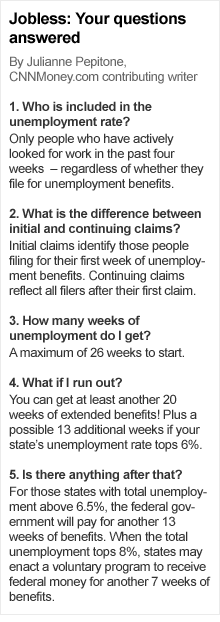
In most states, the unemployed receive a maximum 26 weeks of state-funded benefits. Two extension programs may also be available for an extra 53 weeks of benefits. (Click here for further detail on unemployment benefits programs.)
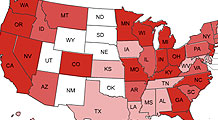
The availability and duration of the programs depends on the state's unemployment rates and whether it agreed to participate in part or all of the federal programs. (View the map to see how many weeks of benefits your state offers.)
These extension programs are "difficult to understand, unprecedented and tough to administer," noted Heidi Shierholz, an economist at the Economic Policy Institute, a nonprofit think tank. "It surprised me how difficult it is to get data on this. I study labor markets all the time, and even I didn't know just how much of a behemoth it is."
But just because filers may not be counted in the weekly jobless claims data, it does not mean they don't impact the national unemployment rate. The Labor Department doesn't rely on unemployment-benefit claims to calculate the unemployment rate; instead the agency conducts interviews through a population survey and simply asks people if they have looked for work in the past four weeks. If they have, they're included in the rate.
So, if you have run through all of your benefits and say, "yes," you would still impact the unemployment rate. If you are unemployed and looking for work but aren't claiming benefits, you would be included as well.
Still, the weekly jobless claims number is a good indicator of the health and direction of the economy. And Edward Stuart, an employment economics expert from Northeastern Illinois University, believes the NELP's data may even be "conservative."
"The unemployment rate is going up, and the time spent unemployed is also going up," Stuart said. "Jobs are disappearing, and we aren't replacing them."
In the meantime, Ridinger waits -- checking about 80 Web sites daily and has applied for jobs all over the country in a variety of fields. After almost a year, he's had only one interview.
"This experience has hit me with every possible emotion," he said. "It's humiliating, degrading. I've changed my complete attitude toward the system. I just never expected to be a part of it."
Have you run through your unemployment benefits? E-mail your story to realstories@cnnmoney.com and you could be a part of an upcoming story. 



