
Minimum wage hike: More money or fewer jobs?
On Friday the federal minimum wage jumps to $7.25 an hour from $6.55. Economists differ as to whether that will hurt or help low-income workers.




NEW YORK (CNNMoney.com) -- On Friday, the federal minimum wage rises for the third year in a row, sparking the perennial argument among economists: Will it help workers at the bottom of the ladder, or will it kill their jobs?
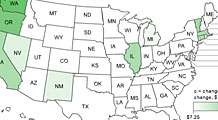
The U.S. minimum wage goes to $7.25 an hour, from $6.55, according to the U.S. Department of Labor. Most states have their own minimum wage, and employers are required to pay whichever is higher. That means minimum wage workers will get a raise in 29 states and Washington, D.C. In the remaining 21 states, they'll see no change.
In some states, the increase will be more modest. In New York, the state minimum wage is $7.15 an hour, so workers there will be paid an extra dime an hour, which means another $4 for a 40-hour week. But in states like Georgia, Virginia and Texas, workers are paid the current federal minimum of $6.55, so they'll get the largest raise of 70 cents, which translates into a $28 bump for a full-time week, or more than $1,400 a year.
Kai Filion, an economist with the Economic Policy Institute in Washington, estimated that more than 2.8 million workers will have their wages lifted to $7.25 an hour on Friday. More than 1.6 million workers will also be indirectly affected, according to Filion, meaning their above-minimum wages will increase as the rising tide lifts all boats.
That adds up to nearly 4.5 million workers who would get a raise. The impact varies widely from state to state, depending on state minimum wages and population. In New York, with its $7.10-an-hour state minimum, 63,000 workers would be directly impacted, according to the EPI, compared with 632,000 workers in Texas.
"Because it's not a big increase, any impact will be modest, but it will be good," said Heidi Shierholz, a minimum wage expert with the EPI. "You're seeing people say this is a wrong time to do this, but I think that is entirely wrong-headed. They could not have planned this for a better time."
Based on Filion's estimates, the wage increase will inject $5.5 billion worth of extra spending into the economy over the next year.
"It gets additional money to low-wage workers," said Shierholz. "These are workers who are mostly struggling to get by and will spend that extra cash. This is actually stimulus."
Back in 2007, before the current recession began, Congress passed a bill to increase the minimum wage, which was then $5.15 an hour, three times over three years.
Some economists believe that the Friday increase couldn't be happening at a worse time. The U.S. economy lost nearly 3.4 million jobs in the first half of 2009, which is more than the 3.1 million lost in all of 2008.
Suzanne Clain, professor and living wage expert at the Villanova School of Business in Pennsylvania, said that increasing the minimum wage would create additional financial hardships for employers, driving the nationwide unemployment rate above its current 9.5%.
"My feeling is that increasing the minimum wage is going to put additional strain on the economy," she said. "Additional jobs will be lost as a result. It puts stress on employers who are currently having very small profit margins."
Clain conducted an analysis showing that the 13 states with the highest minimum wage -- exceeding the upcoming federal minimum of $7.25 an hour -- experienced higher unemployment levels than the other 37 states. She said the unemployment rates were higher by an average of between 1.75% and 2% in those 13 states during the three-month period ending in May.
"Raising minimum wage rates will generally discourage businesses from employing people," Clain said. "We're already suffering from a downturn phase."
Regardless of whether Friday's increase has a beneficial or negative effect on minimum-wage workers, there is one group that it always seems to leave behind, according to the National Employment Law Project: waiters, waitresses and other workers who rely on tips.
NELP, a New York and Washington-based advocacy group for low-wage workers, released a recent study highlighting the fact that the minimum wage for tip workers has remained frozen at $2.13 an hour since 1991. According to NELP, the buying power of this wage has fallen 36% over the last 18 years.
"This disproportionately affects women," said Raj Nayak, a lawyer with NELP. "Waiters around the country have three times the poverty level of other workers. It's hard to depend on tips."
To NELP, the solution is obvious: Raise the minimum wage for tipped workers. In the study, the group said the federal government could follow the lead of some 13 states that guarantee tipped workers 60% of the minimum wage, which was actually a federal policy until 20 years ago.
Better yet, the study suggests, the government could extend the same federal minimum wage to tipped workers as to any other wage earners, noting that this is already practiced in seven states, including California and Nevada. 



