
Toxic assets still festering
The Congressional Oversight Panel says the economy is still at risk because bad loans remain on banks' balance sheets.



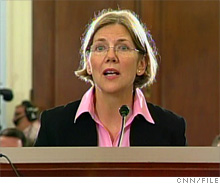 |
| Congressional Oversight Panel chair Elizabeth Warren |
WASHINGTON (CNNMoney.com) -- The economy may show signs of life, but so-called toxic assets are still a major threat to any recovery, a bailout watchdog group warned on Tuesday.
If the economy worsens and unemployment rises further, the troubled assets on bank balance sheets could lose even more value, according to the Congressional Oversight Panel, which keeps tabs on the $700 billion bailout of the financial sector.
The report reminds Congress that the bailout was initially pitched to help deal with troubled assets, hence the name: Troubled Asset Relief Program. Yet the TARP program has not relieved banks of their troubled loans.
The bailout money has instead been used to help banks boost their capital to withstand future losses. Capital injections help ease pressure and potentially free up money for lending -- but the toxic assets are still festering.
"If the economy worsens...then defaults will rise and the troubled assets will continue to deteriorate in value," the report says. "If the losses are severe enough, some financial institutions may be forced to cease operations."
Chaired by Harvard University Professor Elizabeth Warren, the 5-member watchdog panel also cited other concerns, including:
Valuing assets: For example, the report notes that in April regulators gave banks more leeway in how they assign value to assets on their books. Before the rule change, banks had been required to 'mark to market.' The problem was that market prices had been beaten so low that banks would have been forced to incur losses on assets that they were willing to hold on to.
Now, however, the greater latitude for valuation creates confusion about the health of the banks.
PPIP: The report comes as federal agencies are about to kick off a new bailout program called Public Private Investment Program (PPIP). It's meant to more directly address problem securities, but it has been off to a slow start and the report said it's "unclear" whether banks will participate.
Health of smaller banks: The report identifies small banks as a major source of future problems, since they have greater concentrations of commercial loans. And they also won't benefit as much from the federal PPIP program, because smaller banks tend to hold whole loans -- the PPIP program will be aimed at securities.
In addition, the recent 'stress tests' to assess the health of the banking system focused only on the 19 largest banks.
Nobody really knows how big the pool of troubled assets is because there's no agreed upon definition of troubled assets. The panel looked at "level three" assets, which are considered tough to put a value on. Among the top 19 stress tested financial firms, federal officials found $657.5 billion in "level 3" assets in the first three months of 2009, a 14.3% hike in those assets from three months earlier.
The panel recommends, as it did in an earlier report, that bank supervisors repeat stress tests if economic conditions worsen. And the panel suggests that Treasury must consider new ways to restart the market for troubled assets, if PPIP falls flat.
It also suggests that federal agencies should push banks toward more disclosure of the terms and volume of troubled assets on banks books, to allow markets to flow better.
Not all members of the Congressional Oversight Panel agreed with the report's findings. Republican Congressman Jeb Hensarling, R-Texas, suggested that the toxic asset market is "already beginning to heal itself" and that further intervention could be "inappropriate -- if not counterproductive." 



