
Volt vs. Prius: What's the better deal?
It'll take higher gas prices, or a big subsidy from GM, for the new plug-in Volt to be cheaper to drive than the Toyota. But that doesn't mean it won't find buyers.




Find your next Car


NEW YORK (CNNMoney.com) -- The Volt may get 230 miles per gallon, and GM says it will cost only 40 cents to charge up the car from a regular household outlet. But guess what...it still might not be worth it to buy one.
The problem: You might not save enough on fuel costs to compensate for the likely higher sticker price.
The Volt is designed to go 40 miles on battery power alone. Since most people drive 40 miles or less a day, according to the Transportation Department, most Volt owners wouldn't need a drop of gas for daily driving.
But even if GM is able to live up to that promise, a couple of things have to happen for the Volt to beat out traditional gas-powered vehicles on cost, let alone other fuel efficient vehicles, such as the hybrid Toyota Prius.
First, GM will have to price the car far less than it costs to build it, a subsidy that the still financially troubled automaker could have trouble affording.
Second, gasoline prices will need to go higher and stay higher.
The Prius, with its own price premium, doesn't always make economic sense compared to some cheap gas-only models. That price difference hasn't stopped it from becoming a sales success.
Concerns about where gas prices might go in the future, and the desire of a growing number of consumers to drive a "green" vehicle will likely support demand for the Volt, especially given GM's modest initial sales goals. But it's likely most Volt buyers aren't likely to save money by kicking the gasoline habit.
Here's how the math works out.
The Transportation Department says three out of four drivers drive 40 miles a day or less, most drivers wouldn't use the gasoline engine at all, and could get by on electricity only.
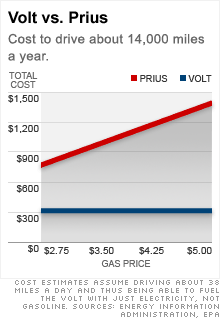
The Volt will use normal household outlets and would charge overnight. GM's CEO Fritz Henderson said it might cost consumers in Detroit paying off-peak rates only 40 cents to recharge the vehicle. But relatively few utilities offer off-peak residential rates. The battery needs about 8 kilowatts hours to recharge, and most consumers would pay about 11 cents a kilowatt hour, or 88 cents. During the course of year, that means a typical Volt owners' electrical bill would increase by $321.
In contrast, the hybrid Prius' electric motor is charged from the excess energy thrown off by the gasoline engine, as well as the energy generated from braking the vehicle.
The electric motor powers the car at low speeds. The gas engine generally takes over on the highway and during fast acceleration or uphill driving. That allows it to get an average of 50 miles to the gallon.
Driving a typical 14,000 miles a year, or 38 miles a day, the Prius would use about 280 gallons of gasoline.
With gas at its current price of about $2.65 a gallon, that would come to about $742 a year in gas, or $421 more than the Volt owners would pay if they can stick with electricity.
Even if gas goes back to the record high of $4.11 and stays there, gassing up a Prius would cost about $1,150 a year, giving the Volt an $830 a year cost savings.
But a Prius costs $25,428, on average, according to sales data from Edmunds.com, while GM will probably have to spend $40,000 or more to build each Volt.
While Volt buyers will get a $7,500 tax credit that reduces the still undisclosed purchase price by that amount, the fact is that GM will have to subsidize much of the remaining $7,000 difference in cost to make it competitive with the Prius.
At current gas prices, the $421 a year savings over a period of six years that a new car is typically owned, would mean that a Volt would only be cost competitive with a Prius if was about $34,500 before the tax credit.
That means GM would have to take about a $5,500 loss on each Volt if it is to be strictly competitive.
If you assume modest sales of 20,000 Volts the first year, that would mean about $110 million in additional losses for the cash-strapped automaker.
Even if you assume a worst case scenario of $5 average price for a gallon of gas over those eight years, it's only worth it to pay a $4,300 premium for a Volt after the tax credit. But that would reduce the loss that GM would need to take on each vehicle by $2,600 to be competitive.
But the Prius itself, and many other hybrids, aren't cost competitive with many gas powered cars. The Prius costs about $6,000 more than the average compact car, according to Edmunds data. If you compare the cost of operating a Prius to a 25 mpg compact car, which is on the low side of that class, you find a savings of about $750 a year for the Prius over the gas burner. And that would mean it only makes sense to spend about $3,500 more for a Prius, not $6,000.
Of course higher gas prices can make the Prius more cost competitive with its cheaper gas-only competitors. Driving more city miles can also increase the cost advantage for a Prius. That's a cost advantage that doesn't necessarily work for the Volt because the additional miles for the Volt use gasoline, not electricity, to fuel the car.
But the Prius has become a sales success, with U.S. sales reaching a record 181,221 in 2007, before slipping 12% last year as auto sales overall plunged. So it's not impossible that the Volt could become a sales success, even if the strict dollar analysis does not work out for it. 



