CNNMoney.com
Companies Economy International Corrections Pre-market Trading After-hours Trading Winners/Losers/Actives Bonds Currencies Commodities World Markets Money Magazine Real Estate Taxes Jobs Ask the Expert Money 101 Autos Mutual Funds The Help Desk Loan Center Best Places to Live Ask the Expert Ultimate Guide to Retirement Retirement Calculators Rules of Retirement Best Funds Best Places to Retire Fortune Brainstorm Tech Apple 2.0 Blog Big Tech Blog Sectors and Stocks Tech Talk Resource Guide Small Business Makeovers Questions & Answers Small Business Video 100 Best Places to Launch FSB 100 Fortune Small Business Fortune 500 Brainstorm Tech Investing Management C-Suite Rankings Main Create Portfolio Edit Portfolio Create Alerts Edit Alerts

Keep your cash safe

Here's what you need to know about protecting your money in the case of a bank failure.

EMAIL  |   PRINT  |   SHARE  |   RSS
 
google my aol my msn my yahoo! netvibes
Paste this link into your favorite RSS desktop reader
See all CNNMoney.com RSS FEEDS (close)
By Jessica Dickler, CNNMoney.com staff writer

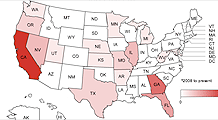
Map
Where the banks are failing
Bank failures and foreclosures keep mounting
DID YOUR BANK FAIL?
  • For more information visit www.fdic.gov
  • Don’t panic – your savings are insured
  • Keep paying your loans – the terms remain the same.
  • The FDIC will notify you by mail about your accounts/loans.
  • Contact the FDIC with any questions until further notice
  • If your bank is purchased, you will be contacted by your new bank.

NEW YORK (CNNMoney.com) -- As yet another bank faces collapse, consumers are worried about their cash.

So far this year, 72 banks have failed, according to the Federal Deposit Insurance Corporation. Struggling southern regional bank Colonial Bank could be the 73rd.

But individuals with deposits at Colonial, or any other troubled bank, are insured by the FDIC for up to $250,000. And in the FDIC's 75-year history, no customer has ever lost an insured deposit.

"When your money is in a bank that is FDIC insured it is backed by the full force of the United States government, and it doesn't get any better than that," said Carol Kaplan, a spokeswoman with the American Bankers Association.

So, if your cash is in an account with less than $250,000 at a bank insured by the FDIC, "there is virtually no way you are going to lose your money," Kaplan said.

Consumers who are worried that their account may exceed the $250,000 mark can spread funds around by opening additional accounts within the same bank -- as long as they are under different names, like a joint account with your spouse or a trust for your children. Consumers can also shield themselves from losses by opening up different accounts with less than $250,000 under the same name, as long as they are at different banks.

Kaplan suggests that account holders speak to a bank employee about strategies to get additional FDIC insurance. Banks will help people reorganize their funds to get full coverage or set up a sweep account, which will automatically move any amount in excess of $250,000 to another bank.

To calculate their personal exposure, consumers can go to http://www.fdic.gov/ and click on the Electronic Deposit Insurance Estimator, also known as EDIE.

When your bank fails

In the case of a bank failure, the FDIC assumes control of the troubled institution and will try to arrange a quick sale to a different bank. If another buyer does not immediately step up, the FDIC will remain in control of the bank until a buyer can be found.

Even under these circumstances consumers can access their deposits within a couple of days, if not immediately, Kaplan said.

But the odds of a bank failure are still relatively rare. The current crop of bank failures hardly comes close to what happened during the savings & loan crisis two decades ago. Between 1987 and 1991more than 1,900 financial institutions went under -- with 534 failures in 1989 alone.

The FDIC disclosed that it was closely watching 305 financial institutions on its "problem bank list" at the end of the first quarter. While that number is higher than it has been in the last few years, there were 2,165 on the list in 1987. The FDIC does not publish the names of the troubled banks for fear of spurring a bank run. To top of page

Features
Markets Last Change
Dow Jones 10,390.11 1.21 / 0.01%
Nasdaq 2,189.61 -4.74 / -0.22%
S&P 500 1,103.25 -2.73 / -0.25%
10-year Bond 99 17/32 Yield: 3.43%
U.S.Dollar 1 euro = $1.484 0.001
December 7, 2009 4:01 PM ET
CompanyPrice% Change
Sprint Nextel Corp 4.19 13.55%
Advanced Micro Devices Inc 8.54 8.65%
Comcast Corp Cl A Special 16.47 7.65%
Gannett Co Inc 11.07 7.58%
Dec 7 3:59pm ET †
More Galleries
Hindsight First came the recession. Now come the books about the roots of the recession. More
Lean muscle cars These days, little engines produce the same power you once needed a big V8 for. Meet 5 new models bringing back the muscle car. More
Holiday gifts for the yoga nut These 7 small brands are helping fuel a booming yoga industry. More
Sponsors

© 2009 Cable News Network. A Time Warner Company. All Rights Reserved. Terms under which this service is provided to you. Privacy Policy
Copyright © 2009 BigCharts.com Inc. All rights reserved. Please see our Terms of Use.
MarketWatch, the MarketWatch logo, and BigCharts are registered trademarks of MarketWatch, Inc.
Intraday data provided by Interactive Data Real-Time Services and subject to the Terms of Use.
Intraday data is at least 20-minutes delayed. All times are ET.
Historical, current end-of-day data, and splits data provided by Interactive Data Pricing and Reference Data.
Fundamental data provided by Morningstar, Inc..
SEC Filings data provided by Edgar Online Inc..
Earnings data provided by FactSet CallStreet, LLC.