
Problem bank list tops 400
Number of troubled lenders continues to mount, hitting its highest level since June 1994, FDIC reports. Deposit insurance fund falls by 20%.



NEW YORK (CNNMoney.com) -- The number of institutions on the government's so-called "problem bank" list surpassed 400 in the latest quarter, climbing to its highest level in 15 years, according to a government report published Thursday.
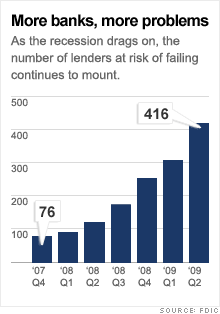
The numbers, published as part of a broader survey on the nation's banking system by the Federal Deposit Insurance Corporation, revealed that the number of banks at risk of failing reached 416 during the second quarter.
The FDIC, which insurers bank deposits, has been hit by a wave of relatively large and costly failures as of late, prompting concerns about the size of the agency's insurance fund. To that end, the FDIC reported that the fund decreased by $2.6 billion, or 20%, during the quarter to $10.4 billion.
The number of banks under scrutiny by regulators has moved steadily higher since the recession began in late 2007. A year ago, the number of banks on the FDIC's watch list was 117. At the end of this year's first quarter, the number stood at 305.
FDIC chairman Sheila Bair said she expected the trend to continue.
"We expect the number of problem banks and failures will remain elevated even as the economy begins to recover," she said Thursday.
The names of the banks on the list are never made available to the general public by regulators out of fear that depositors at those institutions may prompt a so-called "run on the bank."
Regulators indicated that the number of assets controlled by those institutions, however, climbed to $299.8 billion in the latest quarter, up from $220 billion in the previous period.
Over the years, the problem bank list has been viewed as a telling, albeit backwards-looking, barometer on the overall health of the nation's banking industry.
Still, few of the lenders that are on the list actually reach the point of failure. On average, just 13% of banks on the FDIC's problem list have been seized and shuttered by regulators.
So far this year, 81 banks have failed, and dozens more are expected to follow as banks cope with continued losses in real estate and various consumer loans.
As a group, banks lost $3.7 billion during the second quarter, hurt in large part by their decision to set aside money to insulate themselves against bad loans, according to Thursday's report.
In a sign of how much of a trouble spot the issue of credit remains for many lenders, the percentage of loans and leases where borrowers were behind on payments rose to 4.35%, the highest level since banks first started reporting that data to regulators in 1983. Last quarter, the delinquency ratio was 3.76%.
Bair suggested however, that banks might be turning a corner in that respect, citing improvement among some real estate-related loans and a drop in the number of loans more than 30 days past due.
"We're going to need another quarter or two to confirm a trend," she said.
Still, Bair indicated that the agency was bracing for more failures, adding that it would look to replenish the agency's depleted insurance fund. So far this quarter, there have already been two significant bank failures: Texas-based Guaranty and Colonial BancGroup of Alabama.
Bair said Thursday that regulators would likely impose a special assessment on banks sometime next month to help replenish the insurance fund. That's on top of another special assessment against banks earlier this year.
What remains uncertain, however, is whether such precautionary measures would prevent the FDIC from having to tap its $500 billion credit line from the Treasury Department, which was approved earlier this year.
Bair downplayed the idea, but did not rule it out altogether.
Regulators could levy even more assessments against banks to avoid using funds from the Treasury. But such a move could harm many of the banks that are trying to survive the current crisis, notes Frank Barkocy, director of research at Mendon Capital Advisors, a money manager that invests primarily in bank stocks.
Barkocy said that if higher fees "push others to the brink" then the FDIC might want to consider other options, such as money from the Treasury, instead.
--CNNMoney.com senior writer Jennifer Liberto contributed to this report. 



