
Dollar knocked down ... for now
The greenback becomes cheaper to borrow than the yen for the first time since 1993, raising questions about further declines in the already weak currency.



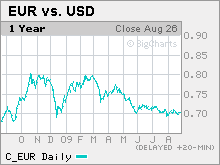
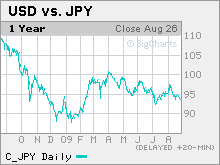
NEW YORK (CNNMoney.com) -- The dollar continued to lose ground Friday at the end of a week in which it became cheaper for banks to borrow in yen than dollars for the first time in 16 years.
The greenback has been retreating since March, when rising stock and commodity prices began luring investors into more risky investments and away from the safety of U.S. currency.
At the same time, the dollar has been weakened by an ever-expanding U.S. budget deficit, which has made some of the nation's main trading partners nervous.
The dollar index, which tracks the buck against a basket of currencies, has hovered near 78 in August, down sharply from a high near 90 in early March.
The ongoing decline was highlighted Wednesday when the cost of borrowing dollars for three months slipped below the rate on similar loans in yen for the first time since 1993, according to the British Bankers Association.
The shift reflects how far bank-to-bank lending rates have fallen since monetary policy makers around the world drastically began slashing interest rates last year and unleashed a tide of liquidity to help forestall the worst economic crisis since the Great Depression.
The trend carried over into Friday, with the Libor rate on 3-month dollar loans at 0.3475% compared with 0.39063% for loans in yen. The London Interbank Offered Rate -- or Libor -- is a daily average of rates that 16 different banks charge each other and is a benchmark for a variety of consumer loans.
"The U.S. economy is awash in money," said Sacha Tihanyi, a currency strategist at Scotia Capital in Toronto. "Liquidity is not an issue."
Put differently, there are simply more dollars floating around now, which makes them cheaper to borrow.
In addition, the Federal Reserve's benchmark interest rate now stands at historically low levels near zero percent, which makes it less expensive for institutions to borrow from the Fed and contributes to lower interbank lending rates.
This has also made the dollar a funding currency for the carry trade, an investment strategy where people use the currency of a country with exceptionally low interest rates to buy higher yielding assets.
The carry trade is popular because it allows investors to earn interest while potentially making a profit on more risky bets. But it only works if investors are upbeat about the prospects for a global economic recovery.
"The carry trade is tied to positive risk appetite," said Boris Schlossberg, director of currency research at Global ForEx Trading in New York. "Carry trades assume global growth and a widening out of interest rates."
If the global economy continues to show signs of stabilization and investors remain bullish, the U.S. dollar could continue to be used as a funding currency for carry trades, he added.
That could further weaken the buck, since investors will continue to favor higher yielding currencies such as the Australian dollar and the euro, at the expense of the dollar.
However, the likelihood of a robust economic recovery remains in question and analysts say the Fed will probably intervene before the dollar falls too far.
That's partly because policy makers want the U.S. economy to become more export oriented and a weaker dollar means lower profits for American producers when their goods are sold overseas.
The U.S. is also under pressure to stabilize the dollar as overseas central banks become more concerned about their holdings of dollars and dollar-denominated assets.
China, which sits on the world's largest foreign-exchange reserves, has called for an alternative reserve currency to challenge the dollar. On Thursday, French president Nicolas Sarkozy also called for an end to the dollar's reign as the primary international currency.
"We're at levels where our trade partners are getting very uncomfortable with the weaker dollar," Schlossberg said. As those partners grow more vocal, that "may force the Fed to raise rates sooner," he added. 



