
Michigan prison closure rattles small-town economy
A prison closure in the state's Upper Peninsula is rippling beyond the barbed wire.



 |
| Michael Hester lost his job as a corrections officer and now he's afraid of losing his home. |
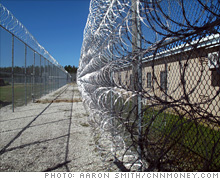 |
| There are no inmates behind the razor wire at recently-closed Hiawatha Correctional Facility in Michigan. |
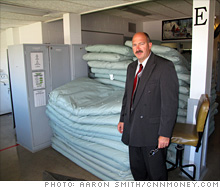 |
| Warden Jeff Woods in front of a stack of mattresses at the abandoned prison quarters at Hiawatha. |
KINROSS, Mich. (CNNMoney.com) -- As Michigan's economy worsened last year, Michael Hester decided it was time to leave the private sector to work in the prison system, figuring a state job as a corrections officer would be more stable.
"I left a better paying job thinking I'd have better security," he said. "I guessed wrong."
On Aug. 8, Hester was laid off from his as job at Kinross Correctional Facility in Michigan's Upper Peninsula. In just one day, the town lost two of its four prisons and nearly 80 officers. One facility shut down, and two other prisons were consolidated into one. Thirty-five officers were laid off, and 43 were transferred to prisons elsewhere in the state, while about 1,000 inmates were relocated out of town or paroled.
Hester made $15.23 an hour as a corrections officer. But now, on unemployment, he's afraid that he and his wife might lose their house.
"In another month or two, money's going to be real tight," he said. "I can't make another mortgage payment on unemployment. I've been looking around [for another job,] but there isn't much out there."
Hester's former boss, Warden Jeff Woods, said that he worked hard to avoid layoffs over the past year by minimizing new hires as older workers retired.
Despite Woods' efforts, that's still 200 fewer jobs in the community including the layoffs and transfers. "Those jobs are gone," he said.
Larry Palma came to Kinross as an 18-year-old recruit in the 1960s to serve at the local Air Force base. The town seemed bleak at first. "I got dropped off at the flagpole in the middle of winter at one o' clock in the morning," he said. "But then I learned to love it because I really love to hunt and fish." After he finished his military time, Palma decided to stay, and now he's the Township Supervisor.
The Air Force built the base during World War II, and it was a major driver of the local economy until it closed in 1977. But town officials successfully lobbied the state to convert part of the abandoned facility into a prison.
"The prison system is what saved us from becoming just a no-man's land," said Palma.
Barracks that were once temporary residences for airmen are now the permanent homes of convicts serving life sentences. The grounds where military personnel use to train and drill are now prison yards where inmates play basketball and lift weights. The remaining prisons, Kinross and Chippewa Correctional Facility, are surrounded by tall double-fences of gleaming razor wire. The now-shuttered Hiawatha facility stands empty, except for the personnel who are stripping it down for equipment that can be transferred to other prisons.
Now Palma is concerned for its survival once again. "As far as the whole impact, we don't know how major it's going to be yet; we just know it's not going to be good," he said. "We know that it's not going to get better. We know that it's going to get worse."
Kinross Deputy Supervisor Dorothy Johnson said the economic results have been "devastating" in this small town, whose 4,300 inmates outnumber its 3,600 residents.
As a result of the closure, Johnson said the town no longer gets $20,000 a month for water utilities it used to provide to Hiawatha. The town will also no longer be eligible for nearly $30,000 in annual state revenue it received from the 1,000 inmates who were transferred elsewhere, as a result of the drop in population. Furthermore, those prisoners used to draw up to 5,000 annual visitors who would spend money in the town's stores, restaurants and gas stations.
But the greatest damage, she said, is to the local real estate market. "For sale" signs have popped up all over town, but there are few buyers.
Housing demand started to dry up in the spring, when rumors first emerged of the imminent closure, according to Joan Reed, associate broker and owner at RE/MAX Eagle Properties in Kinross.
"Potential homeowners and buyers definitely put the brakes on, not just because of a prison closure, but because of the potential for more," she said.
Reed said the instability of the state prison system has changed the way realtors and lenders view officers, who were once considered prime candidates for loans.
Now, she said, a typical corrections officer is considered "probably as a weaker candidate for financing, especially if the income of the family is solely dependent on the corrections officer's income."
Warden Woods, who used to head Hiawatha and continues to lead the Kinross prison, said the average pay for a local corrections officer is about $24 an hour.
"In Michigan, that's a comfortable living," he said. "You're not going to get rich, but certainly you can pay your bills."
And according to Jim Johnson, a union representative for corrections officers who has worked at Kinross for 21 years, the guards earn every penny.
"When you're in there, it's a different world," he said. "Some days are like being in combat in there. Other days are pretty easy, but still, the stress is always there."
Johnson, who is married to Kinross Deputy Supervisor Dorothy Johnson, said a single guard watches over almost a hundred inmates in the prison's housing unit.
"As a corrections officer, when you walk in the door and you've got 96 inmates you'll be working with for eight hours, you better have good communications skills," said Johnson. "You can't just use brute force or you're not going to last. I've seen it tried."
Johnson said 14 of the 35 laid-off officers have been hired back, but he is worried there will be another wave of pink slips, and former guards like Hester aren't expecting to get called back.
"I wish the decision makers in [the state capital of] Lansing would spend a day in a facility and see what's it like," said Hester. "Because they don't need to cut correction officers. It's a dangerous job."
Still, Hester said he would gladly walk the yard again, if only to be able to pay his mortgage. He lives in Hessel, a farm-dotted area near shimmering Lake Huron, where bald eagles are a common sight. He doesn't want to leave it behind, but he realizes that he may have to, even if it means losing his home.
"I could put it up for sale, but it's going to sit there like everything else, because there's nothing selling right now," said Hester. "If I have to lose the house and look for a job somewhere else, I guess I will, but I don't want to leave Michigan. I was born and raised here. I hate to leave it. But I have to do what I have to do."
Have you suffered a setback because of the economy? What are you doing to overcome it and get back on track? If you've been confronted with some challenge during this recession but are fighting back, send an email to realstories@cnnmoney.com and you could be profiled in an upcoming segment on CNN. For the CNNMoney.com Comment Policy, click here. 



