
47% will pay no federal income tax
An increasing number of households end up owing nothing in major federal taxes, but the situation may not be sustainable over the long run.



NEW YORK (CNNMoney.com) -- Most people think they pay too much to Uncle Sam, but for some people it simply is not true.
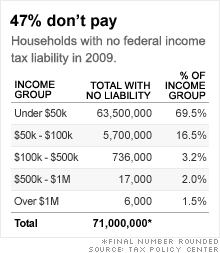
In 2009, roughly 47% of households, or 71 million, will not owe any federal income tax, according to estimates by the nonpartisan Tax Policy Center.
Some in that group will even get additional money from the government because they qualify for refundable tax breaks.
The ranks of those whose major federal tax burdens net out at zero -- or less -- is on the rise. The center's original 2009 estimate was 38%. That was before enactment in February of the $787 billion economic recovery package, which included a host of new or expanded tax breaks.
The issue doesn't get a lot of attention even as lawmakers debate how to pay for policy initiatives like health reform, whether to extend the Bush tax cuts and how to reduce the deficit.
The vast majority of households making up to $30,000 fall into the category, as do nearly half of all households making between $30,000 and $40,000.
As you move up the income scale the percentages drop.
Nearly 22% of those making between $50,000 and $75,000 end up with no federal income tax liability or negative liability as do 9% of households with incomes between $75,000 and $100,000.
Of course, income taxes don't tell the whole story. Workers are also subject to payroll taxes, which support Social Security and Medicare.
When considering federal income taxes in combination with payroll taxes, the percent of households with a net liability of zero or less is estimated to be 24% this year, according to the Tax Policy Center's estimates.
A key reason why there is a zero-liability group at all is because the U.S. tax system is progressive. Those who bring in more money pay more than those lower down the income scale to support government functions such as national defense and social safety nets like Medicaid for those in need. That progressivity can be dialed up or down.
"Some think it's too progressive. Some don't think it's progressive enough," said Roberton Williams, a senior fellow at the center.
President Obama falls into the latter camp. He has proposed increasing the income tax burden on families making more than $250,000 and individuals making more than $200,000, while offering new measures to reduce the tax bite for most Americans making less.
One of Obama's proposals is to extend the 2001 and 2003 Bush tax cuts for everyone except high-income tax filers, which was the group that derived the most benefit from those cuts.
As a result, under Obama's budget, he would keep the ranks of the non-payers higher than they would otherwise be.
The question of who pays and who doesn't is not a trivial matter. But Washington policymakers are not dealing with it in an explicit way.
And that's a problem, given the country's fiscal outlook.
If asked to vote up or down on whether they are comfortable with such a large group of voters contributing no federal income tax or payroll tax revenue, the majority may well decide it is appropriate given the means of the households involved. Or they may decide that it's not.
Either way, that decision should inform the debate about the many costly policies and deficit-reduction strategies that lawmakers will be grappling with for years to come.
"As the number [of nonpayers] becomes larger, we have to question whether we'll make good decisions about how to allocate resources," economist George Zodrow, a professor at Rice University. "Most people don't understand how skewed the tax distribution is."
Experts say that to pay for all the things on the country's growing tab, the money can't just come from a shrunken pool of taxpayers.
"Over the long run, you'll have to have a broader base," Zodrow said. 



