
Even tougher for minorities to get mortgages
Housing bust means it's even harder for blacks and Hispanics to get loans, new federal data shows.




| 30 yr fixed | 3.80% |
| 15 yr fixed | 3.20% |
| 5/1 ARM | 3.84% |
| 30 yr refi | 3.82% |
| 15 yr refi | 3.20% |
NEW YORK (CNNMoney.com) -- The housing collapse has made it even tougher for blacks and Hispanics to get mortgages, according to a new government report.
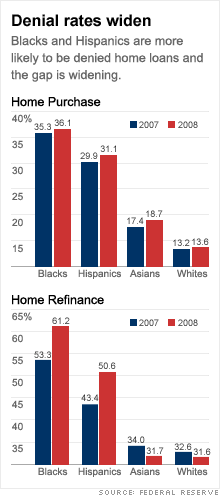
While credit has tightened for everyone, blacks and Hispanics are being denied loans at higher rates than whites, according to new federal data. And the gap is widening.
Lending to black and Hispanic borrowers also fell more quickly than average between 2006 and 2008, according to the 2008 Home Mortgage Disclosure Act data, released Wednesday by Federal Financial Institutions Examination Council. The council consists of the five U.S. bank regulators.
Blacks were denied mortgages 36.1% of the time in 2008, while Hispanics could not get a loan 31.1%, according to the data. Whites had denial rates of 13.6%.
Meanwhile, blacks' share of the loan market tumbled to 6.3% in 2008, down from 8.7% two years earlier. Hispanics' share dropped to 8.5% from 12.1%, while whites' rate jumped to 69.1%, from 62.7%.
These trends reflect the collapse of the subprime lending market. Black and Hispanic borrowers relied more heavily on these high-priced loans for their home purchases during the boom.
Some 43.4% of blacks received high-priced loans, defined as at least 1.75 percentage points above Freddie Mac's prevailing rate, in 2006. Two years later, that rate fell to 5.7%. Hispanics' share of costlier loans dropped from 37.8% to 5.8%. The rate for whites fell from 13.7% to 3%.
The disappearance of subprime lending has led to an explosion in government-backed mortgages. The number of loans backed by the Federal Housing Administration tripled between 2007 and 2008, with 51.4% of black borrowers and 44.7% of Hispanic borrowers receiving FHA mortgages last year.
The trends are not surprising, experts say. The data, however, provides statistical back-up with information on 14.2 million mortgage applicants at 8,388 financial institutions. Banks also reported information on 2.9 million loans purchased from other institutions.
The housing collapse threatens the strides blacks and Hispanics have made in increasing their homeownership rates and building wealth, said Lot Diaz, vice president for housing and community development for the National Council of La Raza, a Hispanic advocacy group. While many people received unsustainable mortgages during the boom, many others were able to secure loans they could afford, he said.
"We fought very hard to open up access to credit to low- and moderate-income families and we're in danger of losing that," said Diaz, who is particularly concerned about jump starting lending.
The collapse of the subprime market isn't necessarily a bad thing, some experts say. Fueling homeownership through unaffordable mortgages isn't good for anyone.
"It's better that they get half the loans they got two years ago if the loans they were getting were toxic products," said Gregory Squires, sociology professor at George Washington University. 



