
College: More expensive than ever
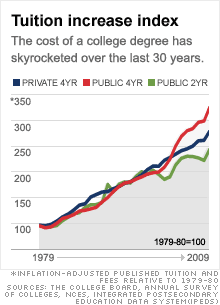
Tuition is climbing at a faster clip than the availability of financial aid, putting a degree further out of reach for many Americans.





| (or part of name) |

|
|

| MMA | 0.69% |
| $10K MMA | 0.42% |
| 6 month CD | 0.94% |
| 1 yr CD | 1.49% |
| 5 yr CD | 1.93% |
NEW YORK (CNNMoney.com) -- College costs are higher than ever, according to a new report, putting a degree even further out of reach for many Americans.
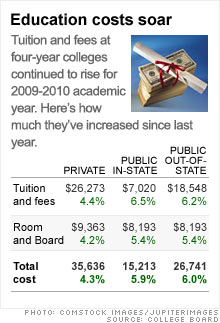
Tuition and fees at private 4-year schools rose 4.4% in the current school year to $26,273, according to a survey released by the College Board Tuesday.
Charges at public 4-year universities spiked over 6% for both in-state and out-of state students, to $7,020 and $18,548, respectively.
"We're in a very strong sellers market for higher education," said Pat Callan, president of the National Center for Public Policy and Higher Education, who noted that the high school graduating class of 2009 was the largest in history.
"Colleges and universities are capitalizing on that more than any other institution in the economy. If you walk around a shopping mall, nobody else is raising prices at the same rate."
Tuition prices are going up at private schools at least in part because those schools have seen their endowments dwindle. Public schools are suffering from a dip in state funding, which declined 5.7% per student this year. (College Cost Finder: Get the latest tuition.)
Less grant money. At the same time, the availability of financial aid isn't keeping up with these climbing costs. Grant funding grew only 4.7% in the 2008-2009 academic year, the most recent for which data is available, which means that undergraduates' out-of-pocket costs are higher than ever.
That, combined with higher unemployment and stagnant household incomes, is making it harder than ever to finance a degree.
The good news, if it can be called that, is that about two thirds of full time students receive financial aid that doesn't need to be repaid. After taking grants into consideration, coupled with federal tax benefits, the net cost of college is much lower than the sticker price. On average, students at private schools are paying $11,900, while those attending public schools are spending about $1,600 out of pocket each year.
That still leaves a third of students paying full freight, and every undergrad is still contending with room and board costs that are also climbing, up 5.4% at public schools at 4.2% at private schools this year.
"Tuition is only one part of the picture," said Sandy Baum, a senior policy analyst at Collage Board. "Even though the net tuition might not be rising for students who get grants, the aid is not enough to cover living costs."
More borrowing. To help bridge the gap between what college costs and what families can afford, student loans are also up. Total borrowing increased 5% between the 2007-2008 and 2008-2009 school years, the most recent for which data is available.
If these trends continue, experts say that it will become even harder to get a college degree.
"If we don't find a way to constrain costs and invest in financial aid at the same time, we won't have any gain in increasing the accessibility or affordability of higher education," said Pat Callan from the National Center for Public Policy and Higher Education.
Callan and his colleagues say that state governors and legislators have to put pressure on public colleges and universities to limit tuition hikes, while trustees must do the same at private schools.
Simultaneously, Callan adds, schools need to invest more financial aid in students who really need it. For instance, at public schools during the 2007-2008 year, two-thirds of grant money went to students without regard to financial circumstances. Students from the lowest income families got an average of just $570 in non need-based grants, while students from upper-middle income families received $730.
But the College Board's Sandy Baum is optimistic that this is one challenge that the education community can address.
"I think that the silver lining to the current problem is that we'll waste less money on kids who don't need it," she said, "and focus on kids who need the funds." 



