
Prices still aren't right for consumers
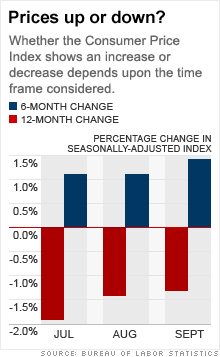
The government's key inflation measure has shown lower consumer prices most of this year, but there are a lot of reasons why it doesn't feel that way.



| |
|
|
NEW YORK (CNNMoney.com) -- The government says consumers are paying less for their everyday needs compared to a year ago. But if it feels like your dollar is not going as far as it used to, you're not alone.
The Consumer Price Index is down 1.3% from a year ago, meaning that the typical market basket of goods and services should be costing you that much less.
But there are a number of factors, some having to do with how CPI is calculated by the Labor Department's Bureau of Labor Statistics (BLS) and some having to do with economic behavior, which can make those savings seem like a mirage.
Here are some of the reasons why your wallet isn't feeling any fatter.
Nothing has driven down overall prices more in the past year than the drop in energy prices. Gasoline prices are down nearly 30% in the past 12 months, but if you strip out falling energy prices, the overall CPI is up 1.2%.
But even though gas may be cheaper than a year ago, it still probably feels like prices are going up. That's because gas prices are up 29% in the last six months.
That obviously can cause a squeeze on household budgets, especially as a weak labor market has resulted in tiny rises in the average weekly paycheck.
Health care is a significant part of consumers' expenditures, topping money spent on gasoline and trailing only housing and food. But calculating the cost of health care is perhaps the trickiest part of CPI, partly because insurance distorts how consumers pay for medical expenses.
According to the Labor Department, overall health care costs were up 4.2% in 2008. For those calculations, the BLS surveyed consumers, medical providers and insurers and tries to come up with a specific cost of medical care.
One reason that healthcare prices appear to have only increased slightly is because if something is judged to be an improved service, such as a new drug, the BLS does not actually consider the higher costs to be a price increase.
That's because the BLS assumes consumers are getting more for their money. But new drugs and treatments are common in the medical industry -- and insurers often charge consumers more for them.
But other calculations show health care expenses, including insurance and other out-of-pocket costs, are rising faster. For example, consumers spent 7% more on health insurance in 2008 than they did a year earlier, according to a separate government reading conducted by the Census Bureau.
And surveys from the Kaiser Family foundation found rises in deductibles, co-payments and other out-of-pocket medical expenses not being captured in either the Census figure or the CPI calculations.
Some government payments, such as Social Security benefits, are pegged to CPI. The current year-over-year decline in CPI means that those benefits won't go up next year. That will be the first time since the cost-of-living adjustment was put in place in 1975 that retirees won't get an increase in Social Security.
Tax brackets and deductions also are pegged to CPI, meaning higher tax bills for many people in 2010 than they would have had to pay if prices were higher.
In the 1990's, then Federal Reserve Chairman Alan Greenspan argued that CPI was higher than justified by economic reality and costing the government money it couldn't afford. As a result, changes in the calculation of CPI were made.
One of the most significant changes was that the government started to assume that if the price of a good rose more than the price of an alternative product, consumers would shift more of their purchases to the lower priced option, limiting the price increase. But even if consumers behave that way, they would still be aware of the higher prices of the goods they can no longer afford.
Because the federal government benefits from lower inflation readings, critics accuse policymakers of intentionally calculating CPI much lower than it should be. Even the BLS admits CPI would be between 0.2 and 0.3 percentage points higher today if the old methods had been used.
Finally, it's very likely that consumers pay more attention to prices that are going up than prices that are going down.
Behavioral economists say people are very sensitive to any financial losses, meaning they will make far more effort to avoid losing or spending money than they will to make the same amount of money.
Robert Frank, a leading behavioral economist at Cornell University, said this well-documented theory is the reason that higher prices make so much more of an impression than the lower prices that might balance it out.
"Price declines don't register with the same intensity as price increases," he said. "Even if they notice it, it's just not going to arouse them in the same way a price increase will. People like to complain."
The fact that overall price decreases aren't keeping up with the record drop in household wealth over the past few years also makes consumers that much more concerned about prices that are rising.
Frank added that with wages flat and credit still tight, products that might have been considered affordable in the past may now be out of reach for consumers -- even if prices are only up slightly.
"Any struggle to make their budgets fit just exacerbates any injuries you feel from the prices that do increase," he said.
Talkback: Have you become a saver? What clever tips do you have for saving a buck? E-mail realstories@cnnmoney.com and you could be part of an upcoming article. For the CNNMoney.com Comment Policy, click here. 



