
The greatest real estate turnaround ever
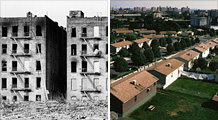
Charlotte Street in New York City's South Bronx was once the epicenter of urban blight. No longer. Now single-family homes line the strip and boats sit in driveways.



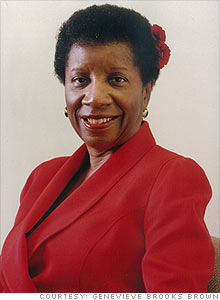 |
| Genevieve Brooks, a driving force behind the turnaround of Charlotte Street. |
| 30 yr fixed | 3.80% |
| 15 yr fixed | 3.20% |
| 5/1 ARM | 3.84% |
| 30 yr refi | 3.82% |
| 15 yr refi | 3.20% |
NEW YORK (CNNMoney.com) -- Charlotte Street was an apocalyptic nightmare version of urban life.
Weed-choked, junk-filled lots flanked the three-block stretch. Burned out tenement buildings punctuated the sky, and abandoned cars littered the landscape.
The street, like much of the rest of New York City's South Bronx, had fallen to epic lows by the late 1970s. The area had disgorged nearly two-thirds of its population as living conditions declined and arson fires raged. Some landlords, unable to find tenants, torched their properties for insurance money. Other blazes were set by junkies, while still more were set by residents of public housing trying to get moved into nicer apartments.
"Charlotte Street was burning," says Genevieve Brooks, a former resident. "Every day, I'd see the fires and smell the smoke. I slept with my shoes by my bed at night because you never knew if your building was next."
Just three miles away, at Yankee Stadium, is where Howard Cosell uttered his famous line: "There it is, ladies and gentlemen, the Bronx is burning."
No longer.
In the three decades since Cosell introduced the world to the plight of the Bronx during the 1977 World Series, Charlotte Street has morphed into a haven of single-family ranch houses accented by backyards flourishing with fruit trees and flowers. Boats sit in driveways and above-ground swimming pools are common. It's a slice of suburbia in one the country's most urban -- and poor -- counties.
What happened to the Charlotte Street that President Carter called "the worst slum in America?" Or the Charlotte Street that President Reagan visited during a 1980 campaign swing? The one he compared -- unfavorably -- with London after the Blitz.
One of the greatest real estate turnarounds ever.
"Charlotte Street is thought of as quite a success story, particularly considering its context: It rose, phoenix-like, out of the ashes," says Nicolas Retsinas, director of Harvard's Joint Center for Urban Studies.
One of the primary catalysts was Brooks, who had moved to Charlotte Street from South Carolina in the 1960s, when the neighborhood was racially mixed and thriving. But as the 1970s dawned, she watched the deterioration take hold.
When she asked her landlord about maintaining her building, he dismissed her. "He told me I should move to Queens, or Park Avenue," she remembers. "I could have left. But I was single at the time, no children, so I didn't have as much to lose."
Instead, she knocked on neighbors' doors and asked if they noticed the change. When they said "yes," she formed a tenants association. Then she helped form a block association to lobby the city to pick up trash and abandoned cars, and to crack down on crime.
"We went down to the cellars and bagged tons of garbage, brought it upstairs and got Sanitation to pick it up," she remembered. "The kids were excited about sweeping the streets. I would give them money for snacks. They would ask, 'Miss Brooks can we sweep the street today?'"
By 1974, tired of the small scale efforts, a host of neighborhood volunteers formed a group they called the Mid-Bronx Desperadoes to lobby for improvements throughout the community.
"There was a tremendous amount of community action," says former Bronx Borough President Fernando Ferrer. "That was the secret ingredient. The community refused to give up. They needed allies. They needed people who took the decline of the South Bronx as personally as they did."
One of those people was urban planner Ed Logue, who was hired in 1978 to run a city agency called the South Bronx Development Office. The city was trying to erase the shame of its worst slums, and to do that Logue knew he would need the assistance of local organizations. The Desperadoes, headed by Brooks, were ready to step into the breach.
Brook's and Logue's vision was to go to the rotted core -- Charlotte Street -- and work outward. But most everyone advised them to rebuild starting from the healthy fringes. They wanted single-family homes; critics wanted density and multi-family dwellings, saying it would promote a lively, safe neighborhood and attract merchants.
"The conventional wisdom was that no one would invest their life savings in such a devastated area," says Julie Sandorf, who worked with the MBD and is now president of the Charles H. Revson Foundation, a New York City-based charity.
Brooks, though, knew most of the families in the area were African Americans from the South, Caribbean blacks and Puerto Ricans, and she was convinced that the long home-owning traditions of these groups would help make a community of single-family homes work.
So she and Logue focused on convincing the Local Initiatives Support Corp., a newly launched nonprofit that had a $10 million grant from the Ford Foundation to assist burgeoning neighborhood revivals.
"There was so much devastation in the Charlotte Street area, it needed a big infusion of dollars," Brooks remembers. "We were in the financial disaster stage."
LISC was indeed interested in assisting in the South Bronx, but the foundation had its doubts about the plan. "People at LISC were skeptical about the notion of doing single-family homes in the South Bronx," says CEO Michael Rubinger. "It was thought to be a crazy idea."
But Logue and Brooks dazzled then-director Anita Miller with a vision of white picket fences. She agreed take a gamble and put up the $125,000 the groups needed to purchase two model homes.
Those first three-bedroom, two-bath ranch homes were manufactured in Pennsylvania and trucked over the George Washington Bridge one night in 1983. Sandorf and her husband were on site waiting for the trucks. The first people they saw was a rough looking street gang -- whom Logue had hired to secure the grounds.
Still, Sandorf says, her husband was a little spooked. "He kept asking, 'Where are all the lights?' I had to tell him all those buildings are abandoned. There are no lights."
The homes were priced at about $50,000, and they sold like hot cakes. "We got more than 600 applications from potential buyers in the first three weeks," says Sandorf.
Within three years, 92 homes would be built on the street and the area re-christened Charlotte Gardens. About 90% of the buyers were from the Bronx, according to Sandorf; many were low-income.
Homeownership was made possible by discounting the houses: Each property sold for between $50,000 and $59,000 even thought it cost an average of $110,000 to build. The difference was funded through federal dollars, but the City of New York and various foundations also helped subsidize buyers.
"The houses in Charlotte Gardens were very deeply subsidized," says former borough president Ferrer. "But it wasn't just city money: That provided a stimulus for financial institutions who were reluctant to lend. We told the banks they had to get involved, they had to get up here and lend. Some admitted they had to eat crow: They never expected the complex to succeed."
But succeed it did. Original buyers invested and stayed; fewer than a dozen homes out of the 92 have ever been sold. Plus, while the rest of the country is being wracked by foreclosures, Charlotte Gardens has lost just one home to the plague.
"The selling of Charlotte Gardens is the extreme opposite story of what happened in the recent real estate debacle," Sandorf says. "It is a shining example of how to do it right. House buyers were carefully selected and vetted. They were subjected to strict credit checks and homeownership counseling."
Property values, too, have soared. Homes that originally went for $50,000 now sell for ten times that -- when one is available. Currently, there is only one for-sale sign on all of Charlotte Street. The owners, who are original, have retired and are moving to Florida. They listed the property for $459,000 -- which is still inexpensive by New York standards. Just across the river, in Manhattan, buyers pay that for a studio apartment.
"Sales are so rare that finding comparables to make an accurate appraisal is very hard," says Tina Gordon, the Century 21 real estate agent for the property.
Genevieve Brooks and her husband retired several years ago and returned to South Carolina, where they have family. But they still come back often to visit friends in Charlotte Gardens.
"We didn't know what we were doing when we started, but we did know we had to do this ourselves," she says. 



