NEW YORK (CNN/Money) -
Federal Reserve Chairman Alan Greenspan said Wednesday the U.S. economy is poised for a rebound, but that the timing of that recovery is uncertain as businesses continues to show caution.
| 
| |

|
|
|
|
|
 Federal Reserve Chairman Alan Greenspan testified before the House Financial Services Committee, and said he sees a number of encouraging signs in the economy. CNN's Louise Schiavone reports. Federal Reserve Chairman Alan Greenspan testified before the House Financial Services Committee, and said he sees a number of encouraging signs in the economy. CNN's Louise Schiavone reports.
|
|
Play video
(QuickTime, Real or Windows Media)
|
|
|
|
|
|
The central bank chairman, in prepared remarks delivered to the House Financial Services Committee, said he sees a number of encouraging signs in the economy, including an improvement in stock prices, a better market for corporate bonds, and an improvement in household confidence.
But he said the Fed will need to keep an eye on developments and that the economy's health will "come into sharper focus only gradually," and warned that business caution could hamper a rebound, citing an alarming recent rise in weekly claims for unemployment insurance.
"Six weeks after the beginning of the war, we have only limited readings on broader economic conditions, and that information has been mixed," Greenspan said.
Some observers hoped Greenspan's testimony might offer some clues about how good or bad the Labor Department's report on April unemployment and non-farm payrolls, due Friday, will be. Economists, on average, expect unemployment rose to 5.9 percent and estimate payrolls shrank by 59,000 jobs in April, according to a recent Reuters poll.
Greenspan's cautious tone -- making special mention of business caution and rising jobless claims -- seemed to indicate Friday's report will be about as bad as most economists think, if not worse.
"Certainly, there was nothing in Mr. Greenspan's testimony to suggest he has seen any strong preliminary data from the April employment report," UBS Warburg chief economist Maury Harris said in a research note.
U.S. stock prices continued to fall during Greenspan's testimony, but recovered somewhat in the afternoon. Treasury bond prices were mixed.
Repeats tax-cut warnings
Though he refused to evaluate specific aspects of President Bush's $726 billion tax-cut plan, Greenspan repeated his earlier warnings that tax cuts could dangerously inflate the federal budget deficit when Congress has few checks on its spending.
| Related stories
|
|
|
|
|
|
"There are powerful reasons to suspect that the elimination of the double taxation of dividends and cuts in marginal tax rates will elevate long-term productivity," Greenspan said. "If, however, in the process we get a significant increase in deficits, which induce a rise in long-term interest rates, that will be a significant undercutting of the benefits achieved by tax cuts."
He also said fiscal policy, including tax-cutting, is difficult to finely tune and time properly, so it makes little sense as a means to stimulate the economy in the short term.
"I tend to be supportive of the employment of fiscal policy for long-term growth issues and to leave monetary policy to be applied in the short run," he said.
Despite comments such as these by Greenspan in recent months, which may have encouraged lawmakers to pare back President Bush's tax-cut proposal, Bush recently said he would nominate Greenspan for another term as chairman in June 2004. Greenspan, 77, has said he would accept the nomination. His tenure would end in February 2006.
Reasons for hope and concern
Greenspan was speaking just days before the Fed's policy meeting next Tuesday. Few economists expect the Fed to cut its target for short-term interest rates, the biggest monetary-policy arrow in its quiver. Lower rates cut the cost of borrowing and encourage economic activity, while higher rates help fight inflation.
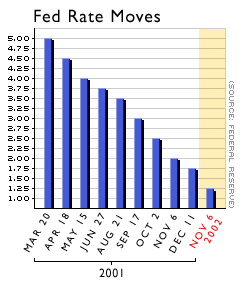
To combat the effects of a recession that began in March 2001, the Sept. 11 terrorist attacks, the corporate malfeasance scandals of early 2002, a prolonged bear market in stocks, and a slow and uncertain walk-up to war in Iraq, the Fed has cut its key interest rate, the federal funds rate, to 1.25 percent, a 41-year low, and kept it there for several months.
In the months leading to the war with Iraq, which began in mid-March and essentially was over by early April, Greenspan and other Fed policy makers said the uncertainties about the war were causing businesses to delay buying new production equipment and hiring workers.
The hope among the Fed and many other economists was that business activity would pick up when the war was over. Though there have been encouraging signs in recent weeks -- higher consumer confidence, healthy retail sales, a gain in stock prices, a better market for corporate bonds -- most economists believe it's still too early to tell if a rebound is really on the way.
In his testimony Wednesday, Greenspan reiterated his hope that things will get better, citing a recent drop in oil prices, continuing low interest rates, and a backlog of orders for business equipment, excluding defense goods and airplanes.
| Also: Greenspan on tax cuts
|
|
|
 Sir Alan bites the hand Just after President Bush offers him another term, the central bank chief slaps the tax cut. Again.
|
|
|
|
But the Fed chairman also noted that price inflation continues to be weak. That's appealing to consumers, but it could be bad news for corporate profits, which would only increase the caution businesses have shown in recent months.
"With price inflation already at a low level, substantial further disinflation would be an unwelcome development, especially to the extent it put pressure on profit margins and impeded the revival of business spending," Greenspan said.
No significant impact from SARS
He downplayed the economic impact of the sudden, mysterious outbreak of severe acute respiratory syndrome (SARS), a pneumonia-like disease that has no known cure and has killed more than 300 people, mostly in Asia, in recent weeks.
He said SARS could be a problem if it interrupts the flow of goods from key Asian trading partners, particularly China -- but there is no sign that such a problem had yet developed.
"There's very little evidence that, outside of the tourist-related aspects of the economies in southeast Asia, much has been impacted," he said.

|