NEW YORK (CNN/Money) -
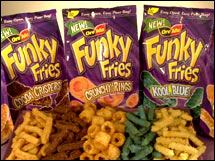
"Simply put, they're not what a potato is supposed to be." This is how H.J. Heinz pitched Funky Fries -- the weird chocolate-flavored and blue-colored fries -- to the world last year.
Consumers never warmed up to these odd fries and a year later Heinz is pulling them off the shelves and blaming disappointing sales of the product as one reason for its fourth-quarter profit miss.
 |
|
| Heinz's Funky Fries, the chocolate, cinnamon, sour cream and blue-colored frozen fries, turned into a product blooper for the company. (Courtesy: Heinz) |
"Kids already like the plain french fries," said Marilyn Raymond, director with New ProductWorks, a Michigan-based product marketing consultancy. "Why try to make them more friendly to kids?"
"What bothered me the most were the chocolate fries," Raymond added. "What was Heinz thinking? Chocolate in french fries is so different that consumers found no cord of familiarity with it. There aren't even chocolate-flavored potato chips out there."
As the Funky Fries fiasco has shown, consumers are pretty fickle, and betting on what sticks and what doesn't is risky business.
For example, among Raymond's list of favorite food failures from the past is Uncle Ben's rice with Calcium. Uncle Ben's Inc. launched the calcium-enriched rice in 1997 with support from the American Dietetic Association, according to New ProductWorks. But it didn't take off.
 |
|
| Uncle Ben's Calcium Plus rice was a flop. (Courtesy: NewProductWorks.) |
"Calcium-fortified food products were not as big back then as they are today," Raymond said. "The rice did not resonate with the average consumer because buyers of Uncle Ben's rice are not daily consumers of the product and therefore will not likely depend on it for their nutrition needs. Drinking orange juice with calcium daily probably works better."
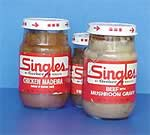
Or how about Gerber's Singles, a variety of fruits, vegetable and other entrees for adult consumers launched in 1974 by the maker of baby food. Consumers had a tough time relating to adult food products sold in baby food jars.
"Companies want to introduce new products that don't cannibalize their existing line," Raymond said. "But sometimes they neglect to think whether or not the product is a good fit with the intended consumer."
If it ain't broke, don't fix it
Perhaps the biggest food flop of all time was Coca-Cola Co.'s (KO: Research, Estimates) decision in 1985 to replace its original secret carbonated formula with New Coke, made with a new formula. It flopped. Coke quickly admitted its mistake and launched Classic Coke, which was the old Coke.
The lesson learned: If it ain't broke, don't fix it.
While changing the flavor can be a faulty move, sometimes the problem is simply a packaging faux pas, like the Garlic Cake made by Gunderson & Rosario back in 1989.
 |
|
| Adults didn't want to eat out of baby food jars. (Courtesy: Gerber) |
The product was supposed to be served as an hors d'oeuvre with breads and meats, but somehow the company forgot to mention that on the label. So consumers were left wondering what garlic cake really was and what the consequences of eating it might be.
Said Raymond, "A new product has to solve a need, even a frivolous one like the need for fun. But how to market that product is just as important."
"Food companies have to pay attention to things like the packaging and the consumer awareness level of the product. That usually means lots of money to support a new product endeavor," she said.
| Related Stories:
|

|
|
|
|
Meanwhile, analysts say the demise of the Funky Fries isn't likely to stop Heinz (HNZ: Research, Estimates) and other food manufacturers from trying to bring out the next best thing.
"The market for packaged foods like ketchup, mustard and frozen goods is a mature market. Therefore companies need to continually innovate. Most food manufacturers also focus heavily on kids because of their potential to create incremental sales for a company's products," said Andrew Lazar, analyst with Lehman Brothers.
"We are no longer shipping or manufacturing the Funky Fries," Heinz spokeswoman Debbie Foster said. But sales of Heinz's other experiment -- the green, purple and pink ketchup -- hit the bull's eye for the company and there's now a new addition to the crazy-color ketchup family.
Blue fries didn't work out. Maybe the new blue ketchup will get a longer shelf life.

|