NEW YORK (CNN/Money) -
The bond market must be very tired.
It spent last week running back and forth, torn between betting on a half-percentage-point interest-rate cut from the Federal Reserve this week and a wimpier, quarter-point cut.
But all this thrashing about was unnecessary -- the Fed's probably going to cut 50 basis points.
"When all [Fed policy makers] have spoken their mind, we think 50 basis points will carry the day," Goldman Sachs economists said in a research note Friday.
Since early May, fear that a sluggish economy could fuel deflation -- an unstoppable drop in prices that cripples corporate profits and economic growth -- had convinced people the Fed would slash its key overnight interest rate 50 basis points to 0.75 percent at its next policy meeting, which ends Wednesday.
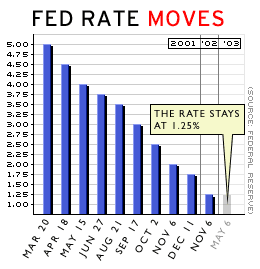
But when the Labor Department said Tuesday its consumer price index (CPI) was flat in May, hopes of an aggressive Fed move sank, and bonds sold like hot cakes -- driving interest rates, which move opposite to price, higher.
A Thursday Washington Post article by renowned Fed watcher John Berry, saying a half-point cut was still coming, briefly stopped the bleeding. But a Friday Wall Street Journal article said a quarter-point cut was still very much in play, sending bond traders to the exits yet again.
Shoot the elephant early
What changed between Monday and Friday?
The answer is: not much. In fact, a Reuters poll taken at the end of last week found, despite the bond market's churn, more economists were betting on a 50-basis point cut than ever.
| Related stories
|

|
|
|
|
"Ninety percent of the people who know what they're talking about are talking about a 50 basis-point cut," said Rory Robertson, interest-rate strategist at Macquarie Equities (USA). "There haven't been sufficient signs of economic improvement."
One current voting member of the Fed's policy-making committee, San Francisco Fed President Robert Parry, said in a June 2 speech the CPI probably overstated inflation anyway, and he sounded an awful lot like the kind of deflation hawk who might want a more aggressive cut.
Many economists agree with the Fed's own research, which has found that, if deflation's a problem, you need to get tough sooner rather than later.
"If the rogue elephant of deflation is charging at you, you use both barrels of your shotgun," said Kevin Logan, chief market economist at Dresdner Kleinwort Wasserstein. "If you use only one and it doesn't stop the elephant, the next barrel probably won't stop it either, so you want to hit it hard the first time."
Spare the money markets, spoil the economy
There are, in fact, really only two possible reasons for not cutting rates more aggressively: It could hurt money-market fund managers, and it could use up all the Fed's ammo too quickly.
Both concerns are debatable.
It's true some money-fund managers are suffering from lower returns. But does the Fed really want to sacrifice the whole economy for the sake of a few fund managers, especially if it can goose people into riskier investments?
"There are about $2 trillion sitting in money market funds, and these funds have to be shifted out; it's not productive use of the money," said Lacy Hunt, chief economist at Hoisington Investment Management in Austin, Texas. "The whole issue has to be what's best for the overall economy."
Of course, some argue that money-fund pain could hurt the economy, since money funds are big buyers of commercial paper, super-cheap business loans that grease the skids of business spending.
But holders of commercial paper will still get a slightly higher rate of return than the Fed funds rate, and most money-fund managers still have costs low enough that they'll make money -- and buy commercial paper -- even if the Fed cuts 50 basis points.
Build momentum now
As for the second potential risk to cutting more aggressively, the Journal article said some Fed officials are worried their "unconventional" policy methods won't be effective and that, once they've cut short-term rates to the bone, they'll have nothing left to help the economy if it's hit by a shock.
But that might be all the more reason to cut rates faster.
"Get the economy up and running as fast as possible, and with stronger momentum, it will be able to keep growing even in the face of a shock," said Northern Trust economist Paul Kasriel. "It's kind of like if you're going fast and you get hit by a wave, it slows you down, but you keep going. If you're hit by the wave and you're not going fast, then you get knocked back."

|