NEW YORK (CNN/Money) – Makeover fever pervades the television landscape. From three-bedroom houses to sloppy straight guys, metamorphosis is the prime time name of the game.
In fact, three popular "reality" shows – "The Swan" (FOX), "Extreme Makeover" (ABC), and "I Want a Famous Face" (MTV) – take the trend as far as this: contestants get to be physically transformed by heavy doses of cosmetic surgery.
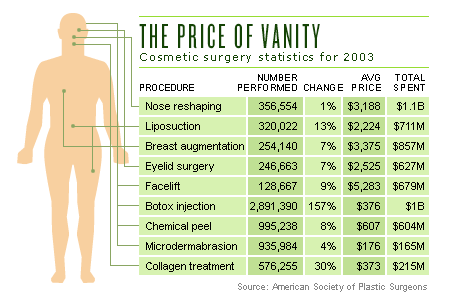
The nip-and-tuck TV shows are both riding a trend and helping to drive it. Doctors performed 8.8 million procedures in 2003, a 33 percent spike from 2002, according to the American Society of Plastic Surgeons (ASPS).
Minimally invasive procedures, such as Botox and collagen injections, swelled 43 percent. More radical cosmetic surgical procedures, such as facelifts and rhinoplasty, increased as well, up five percent.
In all, Americans spent more than $8.3 billion last year on cosmetic surgery.
The ASPS attributes growth in its business to "the entertainment industry, which spotlighted plastic surgery and perhaps, created a larger interest from the public."
"Extreme Makeover" inaugurated the genre back in December 2002. The before-and-after format features a panel of experts acting as the contestant's fairy godmothers, recommending new makeup, hairstyle, clothes, dental work, and plastic surgery.
"Famous Face," which debuted in March, introduced a twist: its participants want to look like specific celebrities. Twin brothers chose Brad Pitt as their model. A singer wanted to duplicate Britney Spears. A pre-op transsexual, J Lo. The show ranks in the Top 10 for young viewers (people between 18 and 34 years old) nearly every week.
"The Swan" premiered this April. Its angle is to take a group of plain Janes, make them over into glamour girls, and then have them all take part in a season-ending beauty pageant. During the first week in April, it was the tenth most watched show on television, with 15 million viewers.
Mothers of reinvention
The American obsession with cosmetic surgery derives from a well-established, deeply ingrained part of the national culture, according to Robert Thompson, founding director for the Center for the Study of Popular Television at Syracuse University.
"The entire history of America is one big makeover show," he says. "Reinvention goes back to the Pilgrims. We left the old world for the new-and-improved one."
For many who desire to burnish their image, money is no object. But even those who can't really afford it often find a way to pay for plastic surgery, says Ann Kearney-Cooke, a Cincinnati-based psychologist and the author of the upcoming book, "Change Your Mind, Change Your Body: Feeling Good about Your Body and Self after 40."
"I've consulted on cases where an 18-year-old girl wanted a tummy tuck, but the family had very little money," she says. "They were still willing to do it to improve the girl's self esteem."
For Thompson, "The Swan" has definitely gone too far. The beauty-contest finale idea leaves a bad taste in his mouth. The obligatory mirror scene in which each contestant looks at her post-op self for the first time and inevitably proclaims, "I'm beautiful," introduces an overdose of what he calls "the cheese factor" into the proceedings.
On the other hand, Thompson deems "Famous Face" to be more cautionary. It documents the operations in graphic detail, doesn't pay for the procedures (as the other shows do), and doesn't sugarcoat the raw emotions on display.
Risky business
The shows tend to make plastic surgery seem little more complicated than "buying a pair of shoes," complains American Society of Plastic Surgeons president Rod Rohrich. "But it's real surgery with real risks"
"You can suffer severe medical emergencies," Kearney-Cooke points out. That was confirmed by the recent death of author Olivia Goldsmith ("First Wives Club") at age 54 from complications during a facelift.
Cosmetic surgery also can fail to deliver its desired effect, leaving patients even less satisfied with the way they look. Debbie Then, a California-based psychologist and author of "Women Who Stay with Men Who Stray," says the practices of many doctors in beauty-obsessed Los Angeles consist of correcting the mistakes of other plastic surgeons.
Thompson points out that in the first episode of "Famous Face," the twins wanted to look like Brad Pitt in order to impress a girl they liked. "It was a sad story with an unhappy ending," he says. "Interviewed after their transformation the girl said she still liked them – but only as much as she did before."
Matthew Felling, media director for the Center for Media and Public Affairs, also worries about the future effects of all this physical perfectionism. "The norm will no longer be the norm," he predicts. "The exceptional will be the norm."
Pop singers now more than ever must have beautiful faces and hot bodies, too. Where would that leave Janis Joplin, Mama Cass Elliot, and Aretha Franklin today?
"We'll have to change the saying from 'It's not over 'til the fat lady sings' to 'It's not over 'til the supermodel with a decent voice sings,'" says Felling.

|