NEW YORK (CNN/Money) – So you carry a balance on your credit card but rationalize that at least you're getting free airline tickets for your spending efforts. Well, you may be an unwitting member of the Suckers Club.

CardWeb.com crunched some numbers on 11 major U.S. carriers who sponsor a credit card. The findings aren't pretty if you don't pay off your balance in full every month.
For starters, CardWeb found that while airline cards give you an average of 1.4 percent back on your purchases in the form of free miles, they also charge about 5.9 percent more in interest than non-rewards cards.
And don't forget to add the annual fee you'll pay for the privilege of paying more interest on that reward card. Most non-rewards cards don't carry annual fees.
Say, for example, you carry a $3,000 balance every month. Between interest charges and fees, you'd pay an average of $482 a year on an airline-sponsored miles-reward card, CardWeb found. That same balance on the best-priced, non-reward card would only cost you an average of $254 a year.
CardWeb tested one scenario to see how long it would take to earn a free round-trip coach ticket valued at $338 from the East Coast to San Francisco if you charged $1,000 a month. Answer: About 24 months.
Assuming you regularly carry a $3,000 balance on that card, and you're paying an average of $482 per year for two years, that's a total of $964 in interest and fees in exchange for that $338 ticket.
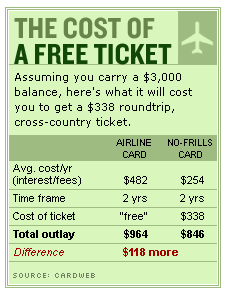
By contrast, if instead you carried that $3,000 balance on the average best-priced non-rewards card, you'd pay $254 a year for two years, bringing your total to $508, plus the $338 price for the ticket. Your entire outlay: $846, or $118 less than if you'd used the miles-reward card.
So in effect, that "free" airline ticket is actually costing $118 more than if you just used the best-priced no-frills card and bought the ticket yourself.
Of the 11 cards CardWeb analyzed, only three (America West, Frontier, and Southwest) would have saved you money compared with the cost of using a non-rewards card from the same issuer and buying a roundtrip ticket on your own.
|
|

|
| CNNfn's Ken and Daria Dolan take a closer look at cash back card vs. frequent flyer miles card. Which is a better deal? |
 Play video
|
|
|
How much money? Between $13 and $91.
Airline-sponsored rewards cards, which make up the majority of the market in miles-rewards programs, can be great deals for some cardholders. Those who pay their balance off in full every month, charge a lot and fly the same airline frequently can make out well.
But CardWeb points out that anyone using these programs – whether carrying a balance or not – should be aware of three potential pitfalls:
- Some programs limit the number of free miles you can earn in a year;
- Getting a free seat can be tough since airlines set increasingly tight restrictions on the use of miles; and
- The programs can be cancelled with very little notice. Make sure you'll use what you accrue sooner rather than later.

|