|
Hard cell by Gates? Computer phone
Paper reports the Microsoft founder thinks mobile phones are a better way to spread computing.
NEW YORK (CNNMoney.com) - Microsoft founder and Chairman Bill Gates believes cell phones are a better way than laptops to bring computing to the masses in developing nations, according to a published report. The New York Times reports that Craig Mundie, the No. 1 software provider's vice president and chief technology officer, told the paper that both he and Gates believe that turning a specially configured cell phone into a computer by connecting it to a TV and a keyboard is the best way to spread the power of computing.
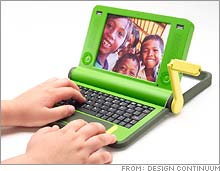
"Everyone is going to have a cell phone," Mundie told the paper, noting that in places where televisions are already common, a phone could be turned into a computer with a cheap adaptor and keyboard. Microsoft (Research) has not said how much those products would cost. The proposal is an answer to a plan by Nicholas Negroponte, the founder of the Massachusetts Institute of Technology Media Laboratory, who in November unveiled his prototype for a $100 laptop computer that could help bring computers to hundreds of millions of mostly-poor students worldwide. The Times reports that Negroponte has failed to reach an agreement with Microsoft on including its Windows software in the laptop. That failure prompted Negroponte to use free open-source software in his laptop instead of Windows, and spurred Microsoft executives to discuss an alternative. "I love what Nick is trying to do," Mundie told the Times. "We have a lot of concerns about the sustainability of his approach." He said there was no firm timing for the cell phone computing strategy, but that Microsoft encouraged such innovations in the past by building prototypes for consumer electronics manufacturers. On Saturday, Negroponte's nonprofit group, One Laptop Per Child, signed a memorandum of understanding with the United Nations Development Program at a news conference at the World Economic Forum in the Davos, Switzerland, under which the two will work together to develop technology and learning resources. He said he has a $20 million commitment to develop the computer, and that he is close to a final commitment of $700 million from seven nations � Thailand, Egypt, Nigeria, India, China, Brazil and Argentina � to purchase seven million of the laptops. Negroponte, who is on the board of cell phone maker Motorola (Research), told the Times he was not opposed to the idea of building a low-cost computer using a cell phone. He said his research group at the M.I.T. Media Lab had experimented with the idea of a cell phone that would project a computer display onto a wall and also project the image of a keyboard, sensing the motion of fingers over it. But he told the paper the lab's researchers decided the idea was less practical than a laptop.
For more on plans to distribute $100 laptops to the world's poor, click here. |
|