|
Ghosn shifts into overdrive
Head of Nissan, Renault talks about plant relocation, hybrids and the Big Three.
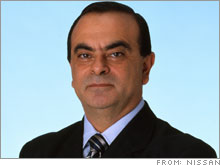
 NEW YORK (FORTUNE) - It's not enough that Carlos Ghosn is running two global car manufacturers -- Japan's Nissan and France's Renault -- that are thousands of miles apart. Ghosn continues to conjure up new business strategies that disrupt his own company as well as the competition. Last week, he set forth ambitious turnaround plans for Renault that include a doubling in the profit margin by 2009. He also decided to rewrite the rules for Nissan's U.S. manufacturing employees by replacing their health care coverage with a small annual stipend.
The clincher comes in April, when 1,240 Nissan employees in suburban Los Angeles must decide whether to follow the relocation of corporate headquarters that Ghosn has ordered to Nashville. Ghosn announced the forced move in January so that he could unite the company's manufacturing, sales, marketing, and other operations together in one location. Already, 20 percent of Nissan's top 60 executives have opted not to make the California-to-Tennessee trek. Never one to shrink from a controversial decision, Ghosn explained his thinking behind the move in a recent interview with Fortune. He also revealed why he's keeping Nissan out of the hybrid race, and why he still holds out hope for the U.S.'s struggling Big Three. Some excerpts: On relocation: "We judge ideas only on the merits of what's the benefit for the company, independent of what's the income it creates. When this [relocation] idea came up three years ago, we asked some people to work on it. What are the pros? Because we know what the cons are. You are going to have people left behind, you are going to have people not happy about it. Are the pros really much bigger than the cons? Because if it is even, forget about it." "We made the case, we debated it. It was very emotional, as you can imagine. We came to the conclusion that this was best for the company and we decided to move." "It is going rather well. We're trying to tell our people in LA, look, this is not a headcount reduction tactic. We really want to create a campus somewhere where cross-functional work is very intense: People in marketing, sales, manufacturing , engineering , product planning, etc., work in harmony to try to make the best for the U.S. consumer. At the same time, we're going to have a new headquarters designed from the inside out." "We are still realistic. We know that many people, for personal reasons, won't be able to move, and this will be a personal loss for Nissan -- we recognize that. But we are going forward anyway because from the other side, we have huge advantages from being co-located." On hybrids: "Before going to mass marketing, you have to make sure that, economically, hybrids make sense. In my opinion, it is still not done. Some of our competitors [read: Toyota] say they are doing things for the benefit of humanity. Well, we are in a business and the company has a mission statement and that mission is creating value. So even though we are pushing our new technology, we want to really concentrate on what's the benefit in terms of emissions, and in terms of CO2 and then say what's the best technology to get this benefit." "The choice of a car is both emotional and rational, and we always have to look at both sides. We want to make sure there is no emotional wave created by the technology that can make it a winning technology even though on a rational basis, it doesn't have so much fundamentals. " On the Big Three: "I've been very consistent on this -- I don't think anything is ever plain in our industry. We are a living case of that. Nobody was in worse shape than Nissan in 1999. And today, we are healthy, we are doing well, we can do much better."
"This is a cyclical industry with problems repeating in different shapes. You'll never convince me there is a hopeless situation or there is any finality in any success or any failure. So I don't consider the game over." |
|