|
Housing surge could be a lot of hot air
Warm weather inflates reported number of housing starts in January, but economists still expect the market to cool.
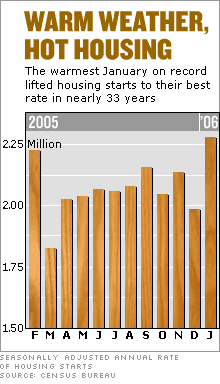
NEW YORK (CNNMoney.com) - Unusually warm weather led to a spike in home building in January, but most experts still believe the real estate market will cool off later this year. Housing starts jumped 14.5 percent to an annual rate of 2.28 million last month, the highest since March 1973, the Census Bureau reported. Economists surveyed by Briefing.com forecast that housing starts would come in at an annual rate of 2.02 million in the month.
But part of the jump came from seasonal adjustments, since government number crunchers usually assume cold weather in January. Instead, the month was the warmest January on record in the United States, which prompted many builders to start work unexpectedly early. "The weather basically gave the builders an opportunity to move things forward. No one changed their plans," said David Seiders, chief economist for the National Association of Home Builders. "But I'll probably change my forecasts for the next two months lower, even if I keep the first quarter forecast at pretty much the same level." Taking out seasonal adjustments, the raw number of housing starts rose 11 percent last month, making it the best January for housing starts on record since the bureau started keeping records in 1959. Still, there have been numerous signs recently that the real estate market is cooling, and most housing economists expect both home sales and residential construction to slip from the record levels reached in 2005. "When one looks at the Mortgage Bankers Association data that reveal that applications for the purchases of new homes are down 7.5 percent on a year-over-year basis, it is not hard to see that the gain reported this month is not a sustainable trend," said Anthony Chan, chief economist for JPMorgan Private Client Services. Federal Reserve Chairman Ben Bernanke said in Congressional testimony Wednesday that a slowing housing market was one of the risks to economic growth, although he expected a gradual slowdown, and for the market to remain robust even as it slows. Good ... for January
Despite the strong "headline" number, economists said Thursday's did little to change their outlook for the full year. "It's a very good number for January," said Phillip Neuhart, economist for Wachovia. "But should we get carried away with the seasonally adjusted number? No. We still expect a slowdown in 2006, no question about it." Still, the report also shows some strength that can't be explained away by the weather. Statistics from the South, which accounts for nearly half of new home construction in the country, and where weather and seasonal adjustments are less of an issue, showed a roughly 9 percent gain in housing starts. Building permits seen as a sign of builders' confidence in the market, came in at an annual pace of 2.22 million in January, up 6.8 percent from December. Permits are much less affected by weather and seasonal adjustments than housing starts. Much of the gain in the permits issued came from a 24 percent jump in multi-family home permits; single family home permits gained only 2.4 percent. "There is some reassurance in that (single-family) permit number that the market is not exploding on the high side, and not collapsing," said the home builders' Seiders. "I still think we'll see them move down, but I expect it will be an orderly slowing from the unsustainable growth last year." The January boom probably also got some help as mortgage rates edged lower. The average 30-year fixed rate mortgage rate was 6.15 percent last month, according to mortgage financing firm Freddie Mac, down from 6.27 percent in December and 6.33 percent in November. But rates have started climbing again, and reaching 6.28 percent -- the highest in nearly two months -- in the most recent reading. _____________________ For a look at dual-mode toilets and other incentives that home builders are offering buyers in the slowing housing market, click here.
For more on the real estate market and what it means for you, click here. |
| |||||||||||||||||||||||||||||||