|
Spitzer brings fraud suit against H&R Block
New York attorney general accuses accounting firm of defrauding customers, seeks $250 million in fines.
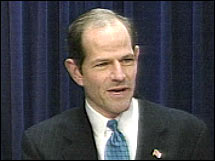
NEW YORK (CNNMoney.com) - New York Attorney General Eliot Spitzer sued the financial services firm H&R Block on Wednesday, accusing it of fraudulent business practices involving IRA accounts marketed to its tax preparation customers. H&R Block (down $1.37 to $20.63, Research) stock tumbled on the news, falling by as much as 8 percent on the New York Stock Exchange.
The suit, filed in State Supreme Court in Manhattan, seeks $250 million in fines in addition to refunds from the Kansas City, Mo.-based accounting firm for steering approximately 500,000 customers into IRA accounts that were "virtually guaranteed" to lose money. Separately Wednesday, class action law firm Lerach Coughlin filed a complaint against H&R Block in federal court in Kansas City, Reuters reported. The class action lawsuit, also related to the tax preparation company's retirement accounts, accuses the firm of breaching its fiduciary duties and using deceptive and unfair trade practices. Customers who opened an Express IRA account were often burdened by unadvertised account fees, making it difficult to grow their savings, said Spitzer, who is currently seeking the Democratic nomination for governor of New York. "(H&R Block) has been advertising itself quite consistently as being in your corner," said Spitzer at a press conference. "I think it is fair to say that they are not in your corner -- they've been putting their clients in the corner instead." Spitzer's suit contends that 85 percent of the account holders lost money after opening an Express IRA account. H&R Block rebuffed Spitzer's attacks, defending the IRA product which has been in existence since 2001. "Make no mistake -- we believe in the Express IRA product and are proud of the opportunities it presents for our client," H&R Block Chairman and CEO Mark A. Ernst said in a prepared statement. H&R Block noted that Express IRA account holders have accumulated over $360 million in savings, more than $50 million in tax benefits and that the interest rates paid on Express IRA accounts remain competitive. An IRA offers a tax-deferred means of saving for retirement, providing investors with a variety of investing options, including stocks and mutual funds. H&R Block's Express IRA, while tax-deferred, only allowed account holders to save funds in an interest-bearing money market account. The civil complaint, which was in response to information from an H&R Block tax preparer, said that company officials were aware that accounts might cost more in fees than they collected in interest. Assessing the fees
Some of the Express IRA account holders carried balances that hovered around the minimum deposit requirement of $300, but were required to fork over a variety of fees -- including a $15 setup fee and a $10 annual maintenance fee, Spitzer said. Upon closing their accounts, individuals were also assessed a closing fee as well as having their account balance hit with a tax penalty. One unnamed 32-year-old from Albany, NY resident cited in the complaint opened an Express IRA account in 2002 with the minimum contribution of $300. The account earned $10.29 in interest over the past four years; the account holder paid $45 in fees over that same period of time. "Had people been told about the fees that were extracted year after year, it is our belief that those investors would have made a fundamentally different choice about whether or not to open these accounts," Spitzer said. The suit, which resulted from an investigation that began in 2005, alleges that in some instances interest on the retirement accounts paid less than one percent annually. An internal H&R Block e-mail obtained by CNN revealed that Spitzer offered to settle the claim for an undisclosed amount prior to Wednesday's announcement. The complaint also noted that many of the individuals who were hit hardest were working families and that H&R Block marketed the Express IRA account to encourage customers to use the company's tax preparation business. The H&R Block suit, which comes just weeks ahead of the tax filing deadline, is the most recent campaign by Spitzer, who has built a reputation of being a watchdog of Wall Street as well as a guardian of consumer interests. -- from staff and wire reports ------------------
Missed out on the rest of the day's business headlines? Click here. |
|