|
Hedge funds getting fat on mergers
The boom in corporate takeovers has propelled a select group of funds to bigger profits in early 2006 than they made all of last year.
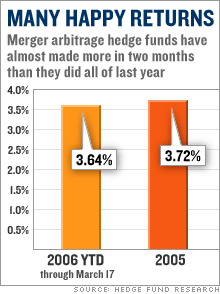
NEW YORK (CNNMoney.com) - Thanks to a spate of blockbuster deals, hedge funds that bet on mergers are on a tear, making almost as much money in the opening weeks of 2006 as they did in all of 2005. These hedge funds use a strategy known in the business as "merger arbitrage" or "risk arbitrage," meaning they seek to profit from the "spread" between the current market price of a company being acquired and the price once a deal has gone through.
Managers of these funds, which are private, lightly regulated investment vehicles for wealthy people and institutions, usually buy the stock of the company being acquired while betting against the acquirer. The "risk" in risk arbitrage refers to the chance that a deal may not close on time, or at all, which would cause the target company's price to drop. Justin Dew, senior hedge fund analyst at Standard & Poor's, said that January was the busiest month for mergers since January 2000, owing to such blockbuster deals as Boston Scientific's $27 billion bid to buy rival medical device maker Guidant and Disney's plans to snap up Pixar for about $7.4 billion. And the deals that have been announced this month -- AT&T agreeing to buy Bell South, McClatchy inking a deal for Knight Ridder, and Capital One announcing a merger with North Fork -- give new meaning to the phrase "March Madness." Nancy Havens, founder of the Havens Advisors hedge fund, said the huge piles of cash companies and private investment funds are sitting on has driven the boom in mergers -- and results at the funds focusing on mergers. "Companies pull back, cut their costs, and pare back excess debt; then they just start generating cash and there's only so much they can do with it," Havens said, adding that the current phase of the economic cycle is a ripe one for deals. "A year ago, it was harder than it is now," she said of running a merger arbitrage portfolio, adding that a boom in mergers usually comes later in an economic growth cycle. "The longer an economy is good, the longer they do mergers. We are in the mid- to late stages of this recovery." Attila Bodi, a partner in the corporate practice at law firm McDermott, Will & Emery, added that despite robust economic growth, interest rates have been relatively low, meaning companies can borrow more easily to finance acquisitions. A greater variety of deals
Dew of Standard & Poor's said that while merger activity is cyclical, the current boom differs from past booms for hedge fund managers because they have a broader range of deals to choose from, meaning that returns for managers betting on mergers will vary widely depending on the deals they pick. That's in contrast to previously when merger arbitrage managers often produced very similar returns since there were far fewer deals to invest in. "There was a lack of deal flow, and what deals they were in offered little opportunity due to tight spreads," Dew said, meaning that the price differences between the target and acquiring companies had shrunk in recent years, making it harder to make money. "You looked at managers and it was like, 'Choose which one you want, they are all the same,'" said Dew. "Now managers have a much broader range from which to choose. They can choose to (over- or under-invest in) certain deals, and that leads to a divergence in returns." Jeffrey Cohen, founder of hedge fund Silverado Capital Management, said the variety comes from the two basic types of deals happening now. One type is the strategic deal, such as Capital One's acquisition of North Fork bank, in which a company buys another to enhance its existing business. The other is the financial deal, when an acquirer buys a company at what it sees as a discounted price and takes it private, then takes it public again several years down the road. In some cases, such as the sale of the Albertson's grocery chain, a company is broken up and sold to a combination of strategic and financial buyers. Cohen said the proliferation of both strategic and financial deals has created a "best of both worlds" scenario for merger investors. The bumper crop of deals this year also means that merger arbitrage managers can stick to doing what they do best -- betting on mergers. In years where there are fewer deals, managers who don't want to sit on a pile of cash have to find other investments to make money. Silverado's Cohen said that he views himself as an arbitrageur -- meaning his fund will try to profit from things like corporate reorganizations and hostile takeovers as well as friendly mergers. But he added that recognizing a lack of opportunities -- in other words, knowing when not to invest at all -- is a skill unto itself. "It's tough to sit on your hands when you've raised money and you see the environment is not good," he said. "Sometimes you just have to exercise discipline and hold off." ------------------------ Clients threaten accused hedge fund manager: More here. Hedge funds flat in February: Click here.
Funds launch, close in record numbers: Full story. |
|