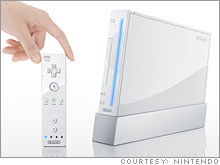
Nintendo, Sega team for gaming iTunes service
Game makers to offer downloadable back catalog of titles for Nintendo's next generation system.
SAN JOSE (CNNMoney.com) – Nintendo's next generation video game system is going to rely pretty heavily on the past. The company announced plans Thursday to offer over 1,000 classic video games from one-time rival Sega and old partner Hudson Software as part of a downloadable collection of games that will be able to be played on the Nintendo Revolution, due out later this year.
The service, dubbed the Revolution Virtual Console, was first announced last May and will also include virtually every title for previous Nintendo home systems. "I consider the Virtual Console the video game equivalent of Apple's (Research) iTunes," said Nintendo president Satoru Iwata in a keynote speech at the Game Developer Conference. Nintendo said it will offer over 1,000 games that were made for the Sega Genesis (not the system's entire collection, but a significant percentage) as well as an unknown number of games for the TurboGrafx, a system jointly developed by NEC and Hudson in 1987. Pricing for the games was not announced. "For young players, classic games are brand new," said Nintendo president Satoru Iwata in a keynote speech at the Game Developer Conference. "For older players, they bring back memories and make you feel good." The Virtual Console will give the Revolution an extensive catalog of games at launch (much like Sony's PlayStation 3 will support all PlayStation 1 and 2 games when it launches). This could be crucial as some third party publishers are still wary of the Revolution and how dramatically different it is than other systems. That wariness might mean they are slower to build original games for Revolution. In addition to offering classic games, Nintendo joined Sony (Research) and Microsoft (Research) in positioning its online service as a potential distribution service for new titles. That could further encourage some publishers or developers to build for the Revolution, since their profit margin would be considerably higher than going through retail channels. Iwata continued to position Nintendo as a disruptive company in the industry, pointing to the success it has had with recent releases such as the Nintendo DS – and unusual title such as "Nintendogs" and the recently released "Brain Age". As he has often done in recent speeches, he criticized the industry for not taking risks with innovation. "It's understandable that many publishers, to reduce risk, rely on sequels," he said. "But the business is beginning to resemble a bookstore – where you can only buy expensive sets of encyclopedias. ... This does not have to be the only business model. We want to help you create a new one." The Virtual Console could pose a risk for Time Warner's GameTap (Time Warner is also the parent company of CNNMoney.com). That service, which also has a partnership with Sega, offers hundreds of game downloads from several classic gaming systems. Nintendo, once a leader in the industry, slipped to third in the current generation. Sony has sold 101 million PlayStation 2 machines worldwide, according to UBS. Microsoft's Xbox has sold 24 million, while Nintendo's GameCube has sold just 21 million. The company hopes by branching out in a direction significantly different than its competitors, it can attract a larger audience, including people who have traditionally not been interested in video games. "Video games are meant to be just one thing," said Iwata. "Fun. Fun for everyone." Sony reveals the PlayStation 3's online plan. Click here.
Morris is Director of Content Development for CNNMoney.com. Click here to send him an email. |
| ||||||||||||