|
Is Wal-Mart boxed in?
Can the company provide 'always low prices' without paying 'always low wages'?
 ROGERS, Ark. (FORTUNE) - Wal-Mart is working hard to get outside its box. It's not going to be easy. The world's largest retailer, with $312 billion in sales last year, is trying to transform itself, inside and out—changing the look of its stores, selling such new products as Fair Trade coffee and $1500 flat-screen TVs, revamping its environmental practices, opening up to critics and trying, within limits, to improve the health care coverage for its employees.
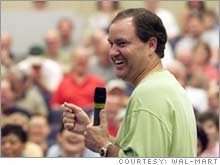
"There are a lot of changes going on at Wal-Mart, and I mean a lot," CEO Lee Scott told reporters Wednesday. All this change is unfolding as well-organized union and activist groups have made Wal-Mart their No. 1 target. Its reputation has taken a beating. Business could be better, too. Revenues and profits are growing as new stores open, but same-store sales growth has slowed. And don't even ask about the stock price. Shares are down by about 15 percent in the last three years, even as the S&P 500 has climbed by more than 40 percent. This week, Wal-Mart (Research) is playing host to about 70 reporters at a hotel near its Bentonville, Ark., headquarters. Lately, the company also has engaged in discussions with environmental groups like Greenpeace and gay rights advocates from the Human Rights Campaign. The theme of this week's media powwow was "Champion the Customer." (More on that, and why it's a not as simple as it sounds, in a moment.) Less boxy big boxes
The most visible manifestation of the new face of Wal-Mart is the look of the stores. Instead of cookie-cutter big boxes, Wal-Mart has built a Colorado store with a Southwestern design and a Florida store that resembles a fisherman's pier. The parking lot in a store in Ohio's Amish country has hitching posts for a horse and buggy. There's no mystery about why Wal-Mart is sprucing up its buildings. The company wants to open more than 300 new U.S. stores in its 2007 fiscal year, but partly because many of its current stores are ugly, the company has run into political and community opposition, particularly in urban or left-leaning areas. Inside, things will look different, too. Wal-Mart execs took pains to say that they are not "going upscale." But the company is expanding its range of products to add fine wines, organic kiwi, luxury bedding, big screen LCD TVs and fashionable clothes. (CEO Scott wore a $12 George tie, bought from Wal-Mart.) By far the most exciting changes at Wal-Mart come under the heading of sustainability. CEO Scott is pushing this, big time. "Sustainability will be integrated into our culture," he said. Some initiatives are straightforward. The company is reducing energy costs in its stores, cutting fuel expenses and designing environmentally-friendly new outlets. "It's good for business," Scott said. Others are more far-reaching and innovative. Wal-Mart has promised to buy more fish from sustainable fisheries. It persuaded Unilever, which makes the laundry detergent All, to reduce the size of its containers by two-thirds, reducing packaging, waste and costs. It is placing big orders for organic cotton. It is selling lots of energy-saving light bulbs. It wants to promote sustainable forestry and mining. Like everything Wal-Mart does, sustainability will have a big impact—especially as the company makes green products more affordable. "We believe that all customers care about products that are good for them, and their families, and for future generations," said Andy Ruben, Wal-Mart's VP of corporate strategy and sustainability. None of this, though, addresses Wal-Mart's biggest image problem, which grows from the perception, if not the reality, that it ought to treat its workers better. This is a complicated issue, especially when it comes to health care. About 48 percent of Wal-Mart's workers are covered by the company's health insurance. Another 30 percent, the company estimates, are covered by a relative's insurance or by Medicaid. This leaves about 20 percent without insurance, meaning that they rely on the government or charity for help. Put another way, Wal-Mart outsources a chunk of its health care costs. The company has been trying to respond and, just this week, announced plans to offer a new low-cost health insurance plan with premiums of $11 a month for the employee and $9 for kids. But the plan will be offered to only half of its employees, and critics say the deductibles are too high. So the argument rages on. Wal-Mart says the problem needs a national solution, while acknowledging that it wants to do better. "Every employer's responsibility is to provide access to affordable health care to its associates," said Susan Chambers, executive VP of Wal-Mart's people division. As for wages, Wal-Mart says its average wage for store associates is $10.11 a hour. Critics dispute that, and dissident workers have told reporters that they earn less than $10 an hour after five years at the company and can't afford health care. Either way, the undeniable fact is America's biggest employer is leaving most of its 1.3 workers to struggle from paycheck to paycheck. Finally, much of what is sold at Wal-Mart is made in overseas factories, where there's little or no protection of workers' basic rights. Wal-Mart has a program to monitor conditions in its global supply chain but other companies—Gap (Research), Nike (Research), Timberland (Research), Reebok, to name a few—do it better, experts say. This issue is, or should be, a worry for Wal-Mart. Champion the customer
This brings us back to the theme of the media event: "Champion the customer." The company displayed quotes from founder Sam Walton to underscore the point: "The customer is the boss." "Customers are number one all the time." Well, maybe. But Wal-Mart's resolute determination to put the customer first practically requires the company to squeeze its workers and suppliers. Yes, Wal-Mart is famously efficient, the world champion at logistics and brilliant in its use of information technology. But you can't deliver "always low prices" unless you work your people very hard and pay them what amount to poverty-level wages. As Charles Fishman writes in "The Wal-Mart Effect," a fine new book about the company, the culture of "always low prices" explains pretty much everything you know about Wal-Mart, for better or worse. "That's a testament to the shaping power of that one idea, which Wal-Mart has turned into an obsession, almost a corporate fetish," he writes. Could Wal-Mart be boxed in by the very idea that made the company so successful? ----------------------------------------------
Wednesday, Lee Scott told reporters the company is in 'transformation.' |
|