Anatomy of a gas gouge
As Bush calls for probes into price fixing, here's how one station fleeced customers for thousands of dollars.
NEW YORK (CNNMoney.com) - Twenty cents here, 30 cents there, and pretty soon you're talking about real money - $10,000 to be exact. That's roughly how much the New York Attorney General's office figures one Getty service station in central New York gouged from motorists in the wake of Hurricane Katrina.
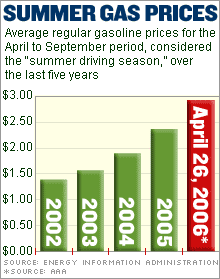
President Bush called on Tuesday for states to keep a sharp eye out for gas gouging, which is defined by most state laws as the act of illegally jacking up prices in times of crisis. Amidst the fresh calls to crack down on the gouging that's been spurred by the recent spike in gasoline prices, the New York attorney general's office recalled just how they busted that upstate Getty station and 18 others like it last fall after Katrina. It starts with a specific complaint - like where and when the motorist bought gas, how much they paid, and the price difference when they returned to the station, said Paul Larrabee, spokesman for New York's attorney general Eliot Spitzer. That's the kind of information regulators need to spring into action. Larrabee said that after receiving complaints, Spitzer's office sent hundreds of letters asking for information from various service stations around the state. The queries included what their lowest price for gas was before the storm, what the highest price was after the storm, and what their costs were both before and after. The upstate Getty station was charging $2.65 for a gallon of regular before Katrina, and $3.52 a gallon after the storm. A rise was to be expected. What was unexpected was that the station was making a 56 cent profit per gallon before the storm and 83 cents per gallon after. That's a 48 percent jump, far larger than the 25 percent increase the attorney general's office considers fair. "It's an unregulated commodity in New York, [so] you can charge what the markets will bear," said Larrabee. "However, when there is some kind of climatic event, you can't punish the consumer for that." He said gas station owners generally took one of two lines of defense when confronted. The first was to say they were just doing what the guy across the street did. The second was to say they heard price increases were coming from their suppliers, so they were merely getting ahead of the game. Larrabee said neither excuse was good, and 15 of the 18 stations that were investigated settled for between $2,500 and $10,000. The remaining three are going to court. But not all cases of rapidly rising prices are examples of price gouging. Some stations, especially those that are independently owned, have to raise prices faster because they don't have long term contracts with suppliers, or large tanks of reserves like many stations that are part of a larger chain, according to AAA's Geoff Sundstrom. "They may have to pay 10, 20 30 cents a gallon more than someone across the street," said Sundstrom. "You can end up seeing a wide variety in price." Other stations jack up the price in a desperate attempt to avoid running out of gasoline altogether, so they can remain open to sell their convenience store fare and keep employees working, said Paul Fiore, a spokesman for the industry group Service Station Dealers of America and Allied Trades. "Attorneys general tend to be a little overzealous with this stuff," he said. "They tend to scapegoat the service stations to get the public off their back. I have real concerns about this." But Larrabee was quick to note that of the hundreds of complaints they investigated, only 18 were deemed worthy of action. With prices on the rise - AAA said the average for a gallon of regular hit $2.92 Tuesday - and Bush's call for more vigilance, state officials will be under more pressure to act. Bush also said on Tuesday that investigations were continuing into price fixing at the wholesale level, which unlike retail gouging is a federal antitrust matter. ______________ Bush seeks to curb oil tax breaks. Click here
5 things to watch in energy. Click here |
| ||||||||||||||