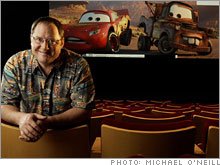
Pixar's animation genius sounds off
John Lasseter talks about the making of the surprise $7.4 billion deal that put creative direction of Disney's animation operations into the hands of its former partner.
 NEW YORK (FORTUNE) - When Disney bought Pixar, the upstart studio took over the creative direction of Disney's own once-renowned, now-flailing animation operations . For Iger, the deal is a bet-the-house gamble to save Disney animation from creative oblivion. For Pixar (and now Disney) animation head John Lasseter, who once got fired by Disney (Research), it is sweet vindication. Here he tells in his own words how the deal got made. (This is an excerpt from an article that ran in the May 29 issue of FORTUNE. For the complete story, click here, or go to www.fortune.com)
The on-again-off-again discussions with Michael Eisner to get a new deal with Disney had to be the most frustrating negotiation on the planet. We would tell them what we thought was important, and the next thing you know, what we asked for was leaked into the public. And then we had to wait months for them to come back to us with a counterproposal. It was just crazy. It would have been easier just to walk away, but Steve [Jobs] stayed in there for me, because I loved these characters that we have created. They're like family, like children. And if we didn't get a deal, Disney would own our children. Who knew what they would do? These were the people that put out "Cinderella II." We believe that the only reason to do a sequel is if you have a great story, period. It's not "Let's just keep cranking it out." So we started talking to other studios. This was in January 2004. But later it became clear that Disney's board was getting serious about replacing Michael Eisner, so we decided to wait and see what happened. As it turned out, I got a call from Bob Iger the day it was announced that he would take over as CEO. And that said a lot to us, because he was serious about wanting to make a deal with us to keep distributing our films. He understood that the biggest issue for us wasn't money, but to have control of our characters. Bob also realized immediately that Disney's reputation with families had dropped because the stuff they were making wasn't as high quality as it used to be. It was more about quantity, not quality. I'm not exactly sure how the idea of Disney's acquisition of Pixar came up, but at first I was very nervous. We have this precious entity that is Pixar. It's like a living organism, like we had found out a way to grow life on a planet that had never supported it before. We wondered if a deal like this would ruin it all. But Steve said to Ed [Catmull, Pixar's founder and president] and me, "Get to know Bob Iger. That's all I can say. He's a good man." Bob came up to my home, had dinner with me and my wife, and met my kids. And right away I realized this guy is different. It's not that he was just saying the right things. You could feel that he meant it. I think the simplest thing was that he readily admitted what he didn't know and was comfortable with that. But he said he did know one thing: that animation is the heart, soul, and engine that drives this train called Disney, and that it was broken, and that it needs to be fixed. He told me his epiphany happened when Hong Kong Disneyland opened last fall, and he was there with his young kids watching the opening-day parade. He was watching all the classic Disney characters go by, and it hit him that there was not one character that Disney had created in the past ten years. Not one. All the new characters were invented by Pixar. That's when he made the decision. I was still nervous about how Pixar was going to change if it became a part of Disney. And Bob simply said, "This is going to be very expensive, so it's in my best interest to do everything I can to keep it the same." He was so calm and logical. No politics, no hidden meaning. And what I realized is that Steve was right about this guy.
This is an excerpt from an article in the May 29 issue of FORTUNE. For more from Lasseter on his first career at Disney and the birth of computer-generated animation, click here or go to www.fortune.com. |
| ||||||||||||