Jobs report leaves Fed with a task
Weaker-than-expected payroll number, coupled with slow wage increase, could allow central bank to pause rate hikes in June.
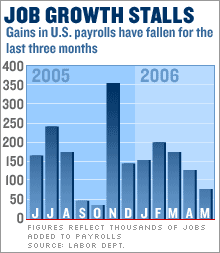
NEW YORK (CNNMoney.com) - Employers added fewer workers to payrolls in May as the government's latest reading on labor market strength came in well below Wall Street expectations, raising hopes that the Federal Reserve will stop its course of rate hikes at its June meeting. There were 75,000 more U.S. workers in May, according to the closely watched Labor Department report. That compares to the revised 126,000 gain in April. Economists surveyed by Briefing.com had forecast that the government's survey of employers would show a 170,000 pickup in payrolls.
Even with the weaker-than-expected jobs gain, the unemployment rate fell to 4.6 percent from the 4.7 percent reading in April, as a separate survey of households showed a much bigger estimated gain in those with jobs. Economists had looked for that number to stay unchanged. But the household survey is widely considered to be less reliable than the employer survey by most economists. Also catching the attention of economists and investors is the report's estimate of average hourly wages, which rose only 0.1 percent to $16.62 after a revised 0.6 percent rise in April. That jump in wages in April had stirred some inflation fears. Economists had forecast only a 0.3 percent gain in May. "The fact that the average hourly earnings were essentially flat is further evidence the bounce we saw last month was a fluke," said David Wyss, chief economist for Standard & Poor's. "There's certainly no inflation coming from the job market." Fed pause seen as more likely
The Federal Reserve has raised interest rates at its last 16 meetings in order to combat inflation pressure. Policy makers there have said it would look to economic data to determine what it will do at its June 29 meeting. The weaker-than-expected labor market and the modest wage increase lessen the pressure on the Fed to raise rates. There had been a great deal of debate among economists and investors before Friday's report about whether the Fed would pause. "The pause is back on the table," said Anthony Chan, chief economist with JPMorgan Private Client Services. "I think the effect of prior Fed rate hikes and the slowdown in housing is being seen. The effects of the tightening we've seen so far is now coming through the pipeline." At the close of trading Thursday, the Chicago Board of Trade's fed funds futures - a bet traders make on the Fed's key short-term interest rate - showed a 72 percent chance of the 17th consecutive quarter-percentage point hike at the next Fed meeting. Friday the futures showed a 46 percent chance of a hike in June. "I think this is a number in the 'pause' camp, possibly in the 'we're done' camp," said Mark Vitner, senior economist with Wachovia. Treasury prices shot higher, and the yield on the 10-year note plunged to 5.00 percent in the afternoon from 5.10 just before the report. Stocks were also higher in early trading, then fell as investors tried to assess what's next for both the economy and Fed action. Major indexes were slightly lower in mid-afternoon trading. Some still expect a hike
Some economists said Friday they weren't convinced another rate hike in June was dead, even with the weaker than expected labor market reading. "This certainly supports the pause argument," said Ethan Harris, chief economist at Lehman Brothers, and one of those still expecting a rate hike in June. "However, they have a second picture to worry about with the inflation pressures." Harris said after two Consumer Price Index reports that showed strong gains in prices, even when energy and food are stripped out, the next CPI report becomes even more critical to Fed thinking. "A third unfriendly number in a row would almost force the Fed to hike at June meeting," said Harris. "Our guess, even if we get an inconclusive consumer price reading on June 14, (is) the chances are better than even they'll hike as a way to demonstrate their anti-inflation concerns." Recent readings suggested that consumer prices excluding food and energy are rising at about 2 percent a year, or slightly higher, depending on the measure. The Fed is generally seen as looking to have that inflation reading come in between 1 to 2 percent. Friday afternoon, Chicago Federal Reserve President Michael Moskow gave a speech in which he said it was important for the Fed to keep up the inflation fight, and bring inflation down from its current levels. "If inflation runs near the top of the comfort zone for long enough, people may begin to question whether that zone accurately reflects our policy," he said in prepared remarks. "I think monetary policy should be calibrated to bring us back to the middle of the range over time." As for the jobs report, Moskow said the 4.6 percent unemployment rate "likely indicates a vibrant labor market," and that even with the lower than expected gain in the payroll number, that the rate of job growth "on balance has been solid in recent months." But other economists argued that the slowing job growth signals a widely anticipated slowdown in the economy, which should help contain inflationary pressures by themselves. "The Fed has been hiking rates for two years now. It's not surprising we're seeing some impact," said Gus Faucher, director of macroeconomics, Moody's Economy.com. "I think it makes perfect sense for the Fed to say let's pause and figure out what that's doing to the economy." ________________
For more on what the jobs report means to you, the markets and the Federal Reserve, click here. |
| |||||||||||