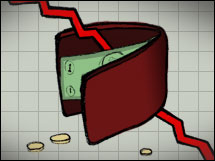
Caution: Slowdown ahead The economy slowed down in the second quarter. But will that be enough to stop more Fed hikes? NEW YORK (CNNMoney.com) -- The beginning of the slowdown in the world's largest economy should start about an hour before the stock market opens on Friday. But even if the government report on gross domestic product shows the dramatic slowdown that most economists expect, that may not be enough to slow the Federal Reserve.
Economists are forecasting that GDP, the broadest measure of the nation's economy, grew at a 3 percent annual rate in the quarter, down from the blistering 5.6 percent pace in the first quarter. Of course, Friday's report won't be the first sign of a slowing U.S. economy. Retail sales fell unexpectedly in June, job growth has been sluggish and the housing market has been cooling. The National Association of Realtors reported another drop in home sales in June, saying the market's now tilted toward buyers for the first time in a long time. Still, while the GDP number is backward-looking, it's likely to send many economists scrambling to update their forecasts for the rest of the year - with many of them cutting their forecasts for growth. But most economists are still on the fence about whether the excepted second-half slowdown will lead the Fed to pause when the central bank meets on Aug. 8 after raising interest rates 17 straight times. Many say they could change their minds about what the Fed will do based on economic reports between now and the next meeting. "This is a close call for August," said Maury Harris, chief U.S. economist at the investment house UBS. Harris is slightly more bullish than other analysts, forecasting second-quarter growth of 3.3 percent, but that's due to a big buildup in inventories. But he said that means second-half growth could be around 2.5 percent, weaker than some of his colleagues. And he said right now he thinks the Fed will raise short-term rates again in August, but then it will be done. But he said that if various employment readings, such as this Friday's Employment Cost Index or the July jobs report, come in weaker than forecasts, the Fed could pause in August. And if the economy cools more than expected in the second half, he sees the Fed quickly reversing course. "If we were to get serious recession signals this fall, they'll start easing like crazy," he said. "They're going to be very responsive on this." But some other economists believe we could already be below 3 percent growth in the second quarter, and that there is a risk of recession later this year that will keep the Fed from hiking in August. "I'm not bold enough to say we're heading for a recession," said Paul Kasriel, chief economist, Northern Trust. "But I think we're on the edge." Kasriel has a forecast of only 2.6 percent growth in the second quarter. "I would characterize housing as in a recession right now, and in this cycle, it's been a more significant factor in the expansion than in past expansions," Kasriel said. "So the weakness in housing is serious." David Wyss, chief economist for Standard & Poor's, also isn't ready to forecast a recession in the second half, though he also sees risks in the current slowdown. "We only have to worry about a recession if something goes wrong. Unfortunately, there are a lot of candidates out there for something to go wrong," he said. But unlike Kasriel, he thinks the Fed will keep raising in August, unless the upcoming GDP or some of the other readings due before August come out much weaker than forecast. "It's close to 50-50," said Wyss about the chances for an August hike. Wyss thinks the inflation reading in the personal income and spending report due Monday, along with next week's jobs report, will be more important to the Fed than this week's GDP reading. "GDP is too rough a number at this point," said Wyss, who said revisions due later to the number make the government's initial reading too volatile. Mark Zandi, chief economist at Moody's Economy.com, also thinks the inflation reading and jobs report are more important to central bankers than GDP. He believes that the economy already has slowed enough that the Fed probably should pause in August, but that it's too uncertain about the risks of inflation to do so. "Because they don't have a crystal ball and they want a little bit of insurance because inflation is uncomfortable, they'll go to 5.5 percent," he said referring to Fed's key short-term rate that now stands at 5.25 percent. Special report: Eyes on the Fed |
| ||||||||||