|
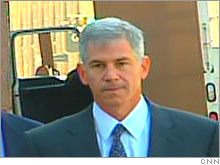
Ex-Enron CFO faces 10 years in prison Despite last ditch efforts to get leniency for Andrew Fastow, a Houston judge could sentence him to 10 years. NEW YORK (CNNMoney.com) -- Almost five years since Enron's infamous implosion, the company's former financial chief Andrew Fastow likely will soon trade his business suit for prison garb. Sentencing is set for Tuesday, and for Fastow it will be the end of a long journey mired by greed, corporate fraud and ultimately the destruction of Enron, once the nation's seventh largest corporation.
Fastow, long considered the mastermind of the off-book partnerships that helped Enron hide millions of dollars in losses, pled guilty in January 2004 to two counts of conspiracy and agreed to accept a 10-year prison sentence and forfeit $23.8 million to the federal government. That 10-year sentence was delayed until after his wife, Lea, served a year in jail for filing a false tax return that helped her husband hide millions of dollars in illegal profits from his side deals at Enron. Now Fastow will come before U.S. District Judge Kenneth Hoyt, who will determine if Fastow will serve the full 10 years or if he deserves leniency for his cooperation in the trial against Enron's former chief executive Jeffrey Skilling and the company's founder Kenneth Lay, who died this past July. Skilling was convicted of 19 counts of fraud, conspiracy, insider trading and lying to auditors. Lay was convicted of 6 counts of fraud and conspiracy related to Enron's collapse and four counts of bank fraud in a separate bench trial. According to court papers filed in Houston, lawyers for Fastow will also argue that Fastow has become a charitable member of the community. "Fastow's attorneys will try to do whatever they can to get leniency for their client but saying that he's a changed man - judges have heard that song before," said John Bielema, a securities litigation defense partner at Atlanta-based law firm Powell Goldstein LLP. "He was the face of the Enron fraud so I don't put much stock in the ability of his lawyers to wash away his sins prior to sentencing." Not much sympathy out there And Judge Hoyt wasn't particularly sympathetic to Fastow's former Enron colleague David Delainey, when he sentenced the former head of Enron's energy trading business to 2 1/2 years behind bars for insider trading on Monday. Delainey, a Canadian citizen, pled guilty to the charge in 2003 and agreed to testify against both Lay and Skilling during their trial. For Fastow, it will be even tougher to win leniency. During Lay and Skilling's trial, both defendants pointed the finger at Fastow as one of only a handful executives guilty of crimes at Enron. Lay testified on the stand that his greatest mistake was promoting Fastow to the position of CFO. "Without Andy Fastow, Enron would not have failed," Lay testified at the time. And while Fastow was long considered the government's star witness, jurors said that his testimony didn't carry much weight given his penchant for deceit in the past and the defense's argument that he was testifying in order to get a lower sentence. "Fastow was Fastow," said former juror Donald Martin shortly after the verdict was reached in May. "We knew where he was coming from." Legal experts said that it's that type of cynicism against Fastow that may ultimately work against him in sentencing. "The judge is likely to be harsh with him," said Jacob Zamansky, principle at Zamansky & Associates, which represents shareholders. "Fastow was really the mastermind of the off-book partnerships and even stole money from Enron. The judge is going to be very offended with that conduct." Zamansky said he expects that Fastow may be sentenced to between 7 to 10 years, if the judge takes into account his cooperation at Skilling and Lay's trial. Still, his plea agreement did not guarantee leniency for testifying at the Enron trial and that could result in the maximum sentence, legal experts said. Other sentences Fastow's sentencing comes as the courts begin the process of sentencing other executives involved with Enron's collapse. Enron's former chief accountant Richard Causey, who was originally slated to be tried alongside Lay and Skilling, cut a deal just weeks before the trial and agreed to serve seven years for securities fraud. Causey was widely expected to be called to testify against his former bosses but he never took the stand. He will be sentenced on Oct. 19. But the main star of the show in Houston's courtroom will be former CEO Skilling, who will be sentenced on Oct. 23. Skilling will be facing between 20 and 30 years in prison. He will be facing a judge alone because of Lay's death. But government prosecutors are attempting to hold Lay's co-defendant Skilling responsible for Lay's $43.5 million forfeiture. That would obligate Skilling to pay $183 million in restitution to government for his and Lay's convictions. Enron's bankruptcy, the biggest in U.S. history when it was filed in December 2001, cost 4,000 employees their jobs and many of them their life savings. Investors lost billions of dollars. Enron's collapse marked the first of the high-profile corporate scandals that rocked the nation, followed by WorldCom, Global Crossing, Adelphia and Tyco (Charts). The wave of fraud led to passage of the Sarbanes-Oxley law that tightened oversight of how American companies are audited. ---------------------------------------------------------------------- |
|