|
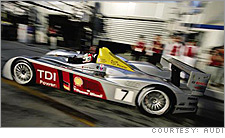
The Axis of Diesel Mercedes, GM and even Honda, are betting on a new breed of green diesels. The goal? To leave hybrids in the dust.  (Fortune magazine) -- As night fell over the 24 Hours of LeMans this summer, spectators at France's prestigious endurance race detected a pattern. While competitors entered the pits to refuel, a sleek pair of Audi R10s kept stealing laps around the 13.7-kilometer track. Already the fastest cars on the course, and eerily quiet thanks to a unique emissions filter, the Audis were also proving the most fuel-efficient. When the checkered flag flew, the Audi had made history as the first diesel car to win a major international race. Diesel isn't just changing LeMans. Thanks to technological breakthroughs, at least six automakers - starting with Mercedes on Oct. 16, Jeep in early 2007, and eventually even hybrid pioneer Honda - will be launching a fleet of New Age diesels. They promise to boost fuel economy by 25% to 40%, with huge torque and turbochargers to deliver the power American drivers crave.
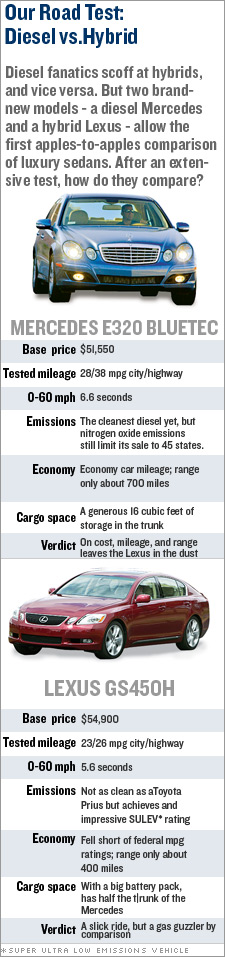
Though initial models won't pass air-quality standards in five states (California and New York among them), Mercedes has announced three 2008 SUVs that will achieve 50-state standards. Honda (Charts), VW, and GM (Charts) are close behind. How big is the market? J.D. Power estimates that diesel sales will triple to 9% of the U.S. market by 2013, compared with a projected hybrid share of 5%. While a diesel may have won LeMans, winning over American consumers won't be easy. "[Toyota's] success has been to put the idea in consumers' minds that hybrids are the only solution, but that's wrong," says clean-diesel proponent Carlos Ghosn, the CEO of Renault (Charts) and Nissan (Charts). Though half the new cars in Europe have diesel engines (credit $6-a-gallon gas and tax subsidies), most Americans still associate the word with soot-spewing, bone-rattling specimens from the '70s. "People ask why we don't just bring them over, but it's a challenge," says Frank Klegon, chief of Chrysler Group's global product development. While hybrids are seen as cutting-edge, "with diesels, it's 'Well, those have been around for 100 years.' " More than 100, actually. Bavarian Rudolf Diesel patented his groundbreaking engine in 1892. While a gasoline engine squeezes gas and air together, a diesel compresses only air, at high pressures, creating so much heat that added fuel ignites without a spark. (Diesel contains more energy than gasoline, and engines burn it more efficiently.) Shifting America's gears Though diesels produce fewer greenhouse gases, they make more smog-forming pollutants. Mercedes debuted the first mass-produced car model in 1936, and popularity peaked here during the early '80s, when four of five Benzes sold featured a so-called oil burner. But the era of cheap gas left most buyers oblivious to fuel economy. As emissions standards got stricter, the EPA even discussed banning diesel a decade ago, notes Margo Oge, director of the EPA's office for transportation and air quality. Except for pickups and a fringe of Volkswagen fanatics, the technology largely fell by the wayside. Until now. The first breakthrough is that ultra-low-sulfur diesel fuel will roll out to the nation's pumps this month. The move was mandated by the EPA, whose 2009 emissions rules will hold diesels to the same standards - the world's toughest - as gasoline cars. (Environmentalists were thrilled, oil companies less so: The rollout will cost them $6 billion to $9 billion.) The new fuel eliminates 97% of sulfur, and it's also the catalyst for automakers to devise strategies to reduce the remaining pollutants. Mercedes is furthest along. In the E 320 Blutec, a trap stores and purges smog-forming nitrogen oxides. A second filter captures particulate matter - diesel's black calling card, long linked to cancer, asthma, and other health risks. Then ammonia compounds are used to convert nitrogen oxides to water and nitrogen. What will consumers notice? It goes fast, it delivers a knockout 38 highway miles per gallon, there's no smell, and it costs just $1,000 more than the gas model, vs. Lexus's $8,000 premium for its GS hybrid sedan. To pass the strictest air-quality rules, part two of Mercedes' plan involves adding a small tank of urea, an ammonia-like fluid that further neutralizes pollution. The EPA's Oge says that while the agency has been leery of emissions systems that require maintenance, it will back Mercedes' approach. By the time Mercedes' 50-state diesels launch, the competition will be heated. In September, Honda - a company long associated with hybrids - announced a catalytic-converter breakthrough that requires no fluid additives, saying it will deliver 50-state models by 2009. And GM recently showed off a burly, ultra-clean V-8 diesel that should arrive around the same time. VW, Audi, Nissan, BMW, and Chrysler Group also have versions in the works. The question is, Are Americans ready for diesel's second coming? "We've always been a proponent," says Mercedes' E-Class chief, Bart Herring. "But changing the perspective of the rest of the market will take time and effort." Honda's research showed that older Americans are more skeptical of diesel. "Younger people are more open to it," says John Watts, Honda's manager for product planning. "They're more our target of who diesel would appeal to - cars with lots of power yet low fuel consumption." In other words, for eco-conscious buyers, the race is on. Camry Hybrid: Save gas, get pat on bac |
| |||||||||||||||||||||||||