Oracle's shopping spree pays offStock Spotlight: Larry Ellison's software company has been on a tear, snapping up smaller rivals. And the party may not yet be over for Oracle's stock.NEW YORK (CNNMoney.com) -- It probably wouldn't surprise anyone on Wall Street if Oracle CEO Larry Ellison had a bumper sticker on the back of his car (or yacht...or plane) that said "Go Big or Go Home." In 2006, Ellison pushed his business software firm to do just that.
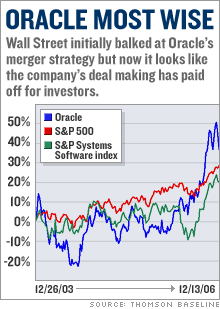
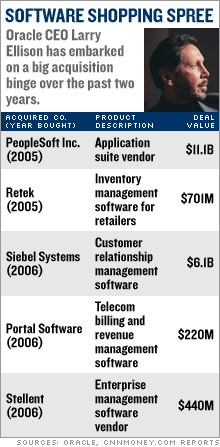
Apart from completing a dizzying number of acquisitions, Oracle's (up $0.05 to $18.07, Charts) stock has soared nearly 40 percent this year, outperforming both the software sector and the broader S&P 500 index. But with the company due to report its fiscal second-quarter earnings on Monday, many on Wall Street are beginning to wonder if the company's spectacular run, punctuated by impressive results from the previous two quarters, is coming to an end. Besides concerns that the company's flagship database business is due for a slowdown, there has been skepticism that the company will not be able to integrate all of the software products from its recent acquisitions. It also has to ward off threats from rivals like SAP (down $0.63 to $51.36, Charts), IBM (Charts) and Microsoft (up $0.43 to $29.98, Charts). On a takeover tear Gobbling up rivals and complementary companies has been a key strategy for the Redwood City, Calif.-based Oracle over the past several years. But 2006 was particularly busy as the company bulked up in the so-called applications business, selling software that allows businesses to automate routine tasks such as payroll administration and customer relationship management. This market is growing more rapidly than database software. So far this year, Oracle completed 13 buyouts, snapping up rivals like Siebel Systems and lesser-known players like Portal Software, which makes billing and revenue management software for the telecommunications industry. While the buyouts still have Wall Street a little jittery, fears that the acquisitions may be an opportunity for rivals to steal part of Oracle's market share have largely subsided, notes Friedman, Billings Ramsey & Co. analyst David Hilal. "In '04 and '05, SAP was taking market share [from Oracle] and prospective [customers] were confused about Oracle's acquisition strategy," said Hilal. "I think those days are gone - Oracle has done a better job of communicating its direction to customers." But most analysts seem to agree that Oracle will look for more deals so it can further diversify its software offerings. Oracle still is a distant second in the applications field behind SAP. Bert Hochfeld, managing director at Hochfeld Independent Research Group, who suspects that Oracle's next target might be business intelligence firms Business Objects (up $0.43 to $38.23, Charts) or Cognos (up $0.04 to $41.99, Charts), says Oracle really has no other choice but to keep shopping. "Oracle desperately needs to do acquisitions to maintain pace," said Hochfeld. "They need the revenue." But the real test for Oracle will be whether it can integrate all of these various software products and make them work. By 2008, the company is scheduled to release a new platform, code named Fusion, which will incorporate many of the products it has acquired to date. That's an undertaking which just about every analyst considers a Herculean task. Richard Williams, an analyst with ICAP who expects the stock to tumble from its current price of about $18 a share to $11 in the next 12 months, says investors assume Fusion will come off without a hitch. He thinks a delayed launch is likely. "The market is significantly underestimating the tech integration risks that Oracle faces," said Williams. All about the data Even though Oracle's recent acquisitions have allowed the company to strengthen its applications business, the company's database software still remains its bread and butter. In the most recent quarter, roughly 71 percent of the company new software license revenue, an indicator of the company's future business prospects, came from its database and middleware division. But some on Wall Street are betting that its flagship database business is due for a slowdown. Last week, Lehman Brothers analyst Israel Hernandez fired off a warning shot, noting that sales of its database software might miss expectations when the company reports its earnings. That sent the stock down nearly 5 percent. The company is expected to report earnings of 22 cents a share, 16 percent higher than a year ago, and sales of $4.15 billion, an increase of 22 percent, according to analysts surveyed by Thomson First Call. Most analysts expect Oracle to meet or beat expectations. But what everyone will be watching is what kind of outlook the company offers. Competition in database software is getting tougher. Oracle is expected to have the leading market share in database software this year, taking 38 percent, according to Forrester Research. But IBM and Microsoft each command roughly a quarter of the market. Oracle: Still a tech sector champ Even though 2006 was a fantastic year for Oracle, most analysts note that the stock still looks pretty darn cheap. Shares of Oracle trade at roughly 16 times estimated earnings for its next fiscal year, which ends in June 2008. That is is relatively inexpensive compared to the larger software universe. Oracle even trades at a discount to SAP. Trip Chowdhry, an analyst with Global Equities Research, points out that Oracle is a riskier investment than SAP but he added that Oracle should report stronger earnings growth than SAP as it keeps acquiring new companies. Certainly, investors should be concerned about slowing growth and increasing competition in the company's database business as well as whether or not the launch of Fusion will be successful. A sluggish economy could also take a toll on Oracle since corporations often pull back on technology spending in a slowdown. But Oracle's saving grace is what it endured so much criticism for - all of its acquisitions. While it may need to take time to make its newly acquired software products seamless, the purchases put the company on the path to greater long term growth. "Oracle is not a quarter to quarter play - it's a journey," says Chowdhry. "People who embark on the journey today will be handsomely rewarded down the road." None of the analysts quoted in this story own shares of Oracle. None of the firms have an investment banking relationship with the company. |
|