NEW YORK (CNNMoney.com) -- Iraqi oil revenue was supposed to cover nearly all the costs of reconstruction.
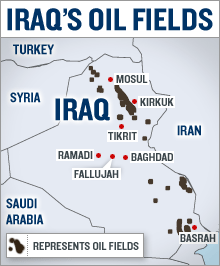
The county's reserves are on the order of 115 billion barrels and, depending on who does the counting, tied with Iran for the world's second largest behind Saudi Arabia's 264 billion, according to the Energy Information Administration.
In early 2003, proponents of the war in the Bush administration said the entire effort might cost as little as $50 to $60 billion. Iraq was though to be capable of producing 3.5 million barrels of oil a day in short order, with that jumping to 6 million barrels a day or more in a few years' time. At current oil prices, that could have meant over $130 billion a year in oil money.
Now the U.S. will pour over $100 billion this year into the country, torn apart by a bloody three-year war, while oil production remains below pre-war levels. The latest EIA estimate said Iraq was pumping 1.9 million barrels per day.
Obviously, the continuing violence is largely to blame for keeping the country's spigots flowing at a relative trickle.
But uncertainty over who controls what fields is also keeping investors, badly needed to repair the country's aging infrastructure, away.
And massive corruption means a sizeable amount of oil - some estimates have been as high as 500,000 barrels a day - goes straight to the black market.
"The fields are still there," said Manouchehr Takin, an energy analyst at the Center for Global Energy Studies in London, who also added that vast parts of the country are still unexplored. "It's the politics that have degraded."
Ongoing violence
First and foremost, pipelines and refineries have to stop exploding.
The best way to do that, experts say, is to give disaffected Sunnis, responsible for many of the infrastructure attacks, a stake in the oil wealth.
At issue is who has the right to sign oil contracts with foreign companies and how the royalties should be divided.
Currently, royalties on existing oil fields go to the central government while royalties on future oil fields go to the regions. But the issues of contract rights and royalty payments are being debated in the Iraqi parliament.
Supporters of more regional control include the Kurds and some Shiites. Oil-rich northern Iraq is largely Kurdish while oil-rich southern Iraq is largely Shiite.
The Sunnis, who tend to have greater presence in oil-free central areas, want royalties to go to the central government and then be doled out based on population.
"Think of how people behave if someone in the family dies without leaving a will, and you'll see how important it is to get this right," said Amy Myers Jaffe, a fellow in energy studies at the James A. Baker III Institute for Public Policy who worked on the recent Iraq Study Group Report.
The report, also known as the Baker-Hamilton report after its co-chairs James Baker and Lee Hamilton, said all oil revenue should go to the central government.
"No formula that gives control over revenues from future fields to the regions or gives control of oil fields to the regions is compatible with national reconciliation," the report said.
Oil companies, which must make multi-billion dollar investments with decades-long time horizons, would also prefer to sign a contract with the central Iraq government rather that with the leader of some semi-autonomous region, said Steven Simon, a Fellow for Middle Eastern Studies at the Council on Foreign Relations.
"The (current) environment for investors is utterly uninviting," said Simon.
But Simon gave the current Iraqi parliament only a 20 percent chance of passing something that quelled the violence, provided a stable legal framework and was acceptable to the Shiites and Kurds.
"A one-in-five chance in the current Iraqi environment is pretty optimistic," he said.
An Iraqi government committee working on the issue deadlocked Wednesday.
As for the Iraqis ramping up production on their own, Simon said it wasn't likely.
"If you're an (Iraqi) oil guy and you've got technical skills, you try to get out of there and get a job someplace else," he said.
Deadly corruption
Corruption is the other problem the country must get resolve before Iraq can get serious about rebuilding its oil industry.
Jaffe said that when the Baker-Hamilton report was being prepared, one Iraqi official told her so much fuel disappears from a big refinery near Baghdad that the country would be better off to just close it down.
Jaffe said those skimmed petrol products are then shipped all over the region by a clandestine trucking network that's been in place since the oil-for-food program limited oil sales under Saddam Hussein. Or the products go to fill shortages in Iraq caused by fuel subsidies that don't allow the market to meet demand.
Profits from these black market fuel sales are a main funding source for insurgent and other violent groups inside the country.
The New York Times recently reported that Iraq's insurgents are now economically self-sufficient and even have the means to sponsor terrorist groups outside the country.
To combat corruption, the Baker-Hamilton report recommended installing meters to measure how much oil flows through a pipeline and then paying security guards based on output, not a flat rate.
The report also recommended reducing the fuel subsidies to better allow the market to meet domestic demand, as well as provide training in areas such as procurement and accounting, to make the industry more transparent.
________________
Energy industry: Give us something solid
Big oil's expensive black gold quest