
GDP growth slower than expectedThird quarter revised down to 2 percent rise as the broad measure of the nation's economy is weaker than expected.NEW YORK (CNNMoney.com) -- The U.S. economy grew at a slower pace than previous estimates, according to a government report on gross domestic product Thursday. The GDP, the Commerce Department's broad measure of the nation's economic activity, grew at an annual 2.0 percent pace in the third quarter, down from the earlier estimate of 2.2 percent. Economists surveyed by Briefing.com had expected the GDP to stay unchanged in this final reading. 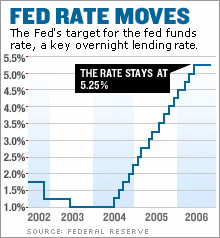 

Wachovia economist Phillip Neuhart said that much of the downward revision could be traced to an even bigger hit than previously estimated from the slump in home building, coupled with slightly slower than expected spending by consumers. Both those trends have been well documented before this report, which limits its impact. "I don't think it's an end of the world kind of revision," he said. "It's still above the first reading (for third quarter GDP), which was at 1.6 percent." But Wachovia and other economists are looking for the economy to slow further in the fourth quarter and into next year. Wachovia's fourth quarter GDP forecast is for only a 1.6 percent rise, which would be the slowest growth seen since the first quarter of 2003. The pace of economic growth is closely watched for clues as to what the Federal Reserve might do about interest rates. The Fed has been keeping rates unchanged at its last four meetings as it cited the risks of a slowing economy. Some investors have been expecting the slower economy could force the Fed to cut rates next year to spur the economy. The inflation measures in the report stayed unchanged from the previous readings. The so called PCE deflator, which estimates prices paid by consumers, was up at a 2.4 percent annual rate, while the so-called core PCE deflator, which strips out volatile food and energy prices, was up 2.2 percent. The core PCE is one of the inflation readings most closely watched by the Fed, and the 2.2 percent reading, while unchanged from the previous estimate, is well off the 2.7 percent rise in the second quarter report. It is also much closer to what is seen as the Fed's comfort range of 1 to 2 percent for that price measure. |
|


