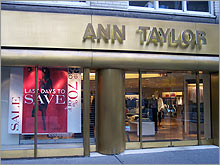
Mild weather melts profits at clothing sellersAnn Taylor, Gap, take hits as heavy discounts on sweaters and coats fail to move goods; some stores betting on spring.NEW YORK (CNNMoney.com) -- Unless Old Man Winter shows up soon, this year's unusually mild winter could devastate crucial fourth-quarter sales and profits at struggling chains like Gap and Ann Taylor and other retailers that have failed to lure shoppers on warm weather gear, even with extra-deep discounts. The damage, and desperation, is showing.
Women's clothing seller Ann Taylor (Charts) slashed prices by up to 70 percent on jackets, coats, scarves. But even so, December sales at its stores open at least a year, a key measure known as same-store sales, still tumbled 5.3 percent. Worse, the last-ditch price-slashing squeezed profits. Ann Taylor said Thursday it now expects full-year profit to be below its previous forecast of $2.07 to $2.12 a share. Analysts' currently expect the retailer to earn $2.06 a share for the year, according to First Call. The fourth quarter includes the critical holiday shopping months of November and December, which account for half of annual sales and profits for many store chains. The year-end selling season - always a hit-or-miss gamble for retailers in general and chains that sell clothing, in particular - has been especially tough this year. For one thing, most clothing chains order their winter inventory several months ahead of the season, so their buyers have to hope that fashion trends don't change too much by the time the season rolls around. Second, when an unexpected weather pattern hits, the only contingency plan retailers have in place involves markdowns to clear out merchandise and avoid getting stuck with excess seasonal inventory. Gap Inc (Charts)., the No. 1 clothing seller, slashed storewide prices more than 50 percent last month to avoid such a situation. But that didn't really work either. Its same-store sales tumbled 8 percent last month. Citing the sales shortfall, the company also cut its full-year profit forecast to 83 to 88 cents a share, from its earlier forecast of $1.01 to $1.06 a share. First Call's current consensus estimate is 96 cents a share for the year. Women's apparel seller Chico's (Charts) and trendy clothier Bebe (Charts) also posted sales declines and both companies issued profit warnings for their fourth-quarter, citing higher-than-anticipated markdowns. Is the weather a valid excuse or not? Well, it depends on who you ask. "Weather was a legitimate reason for disappointing sales for apparel retailers this year, but it won't be next year," cautioned Richard Hastings, senior retail analyst with Bernard Sands. "Climate changes have a long-term effect. So there's no excuse for anyone who cites weather next year because it will be warm again," he said. Eric Beder, retail analyst with Brean Murray Carret & Co., agreed. Beder said he tracked temperatures in 12 cities across the county last month and on average it was 6.4 degrees warmer in those cities versus last year. "It was the warmest in the third and fourth week of the month, which are the key sales weeks of the season," he said. "But I don't know how you segregate that from the overall economic factors that are impacting consumer spending, or fashion misses and changes in the fashion cycle," he said. He gave an example. "Sweater sales haven't been good for years. How much of that trend do you factor into apparel weakness?" Retail expert Howard Davidowitz wasn't buying it. "The warm temperatures have somewhat affected sales of coats and sweaters, but I believe the weather excuse is overblown and greatly exaggerated," said Davidowitz, head of the consulting and investment banking firm. "Is it also true that shoppers bought other products? Yes they did. The accessories business was good. Electronics sales were good. Even sales at high-end apparel sellers were good," he said. "My conclusion is that consumer spending was weak last month and this caused an overall slowdown in buying," he said, adding that outside of clothing, department store operators like J.C. Penney (Charts) and Sears also logged sales softness in December. "Gap and Ann Taylor just don't have exciting products that people want to buy. It's disingenuous for them to blame weather," he said. Mistake to merchandise spring in January? Some chains did well, notably American Eagle Outfitters and J. Crew. Those chains, and some that are struggling (such as Gap), are already adding spring clothing into the winter apparel mix. But Davidowitz said retailers have to be careful about this seemingly ill-timed transition. "If you're a retailer that's missing numbers, you want to blow away what you've got and not add new merchandise. I mean, how does new spring fashion look next to big sales signs?" he said. But for chains like American Eagle, who've posted stellar sales numbers over the past two months, the strategy is a way to add some freshness to the store and capture sales related to post-Christmas gift-card redemptions. Marshal Cohen, chief retail analyst with NPD Group, said it's hard to say if bringing spring clothing into stores three weeks ahead of schedule is a good move. "Companies have to be careful to maintain a happy medium," Cohen said. "Retailers want to keep new and existing customers engaged in their stores. At the same time, stores don't want their shoppers to feel they're getting leftovers." But he is certain about one thing:"Younger shoppers lean more toward newer stuff. So for those retailers that are introducing spring products early, they better be right on the mark with the trend, otherwise they'll have another big problem on their hands," he said. Warm winter chills holiday sales |
|