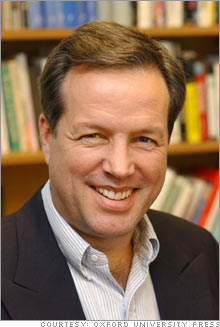
Finding God at workCompanies become 'faith-friendly,' says Fortune's Marc Gunther. NEW YORK (Fortune) -- Most companies strive to be family-friendly. Some brag that they are gay-friendly. But how many are faith-friendly? Not enough, says David Miller, a minister, author and former business executive. Ford, American Express and Tyson Foods are among the better-known faith-friendly firms.
More often, though, companies don't invite their people to bring their whole selves, including their faith, to work, and they are missing an opportunity, he says. "Most people would acknowledge that we as humans are a mixture of mind, body and spirit," Miller says. "If you deny the spirit, you are denying a major part of people's identity." In a new book called "God at Work: The History and Promise of the Faith at Work Movement" (Oxford University Press, 2007), Miller chronicles the rise of a movement among business people who want to integrate their religious beliefs and their work. This is a welcome development, he says, good for business people and for their companies. "The integration of faith and work, when done in healthy, respectful and appropriate ways, and with the recognition that we live and work in a pluralistic culture, is a good thing," he writes. Miller, 50, is "bilingual" in the sense that he speaks the languages of business and religion. He spent 16 years as an executive with IBM and HSBC, earned a PhD from Princeton Theological Seminary and was ordained as a Presbyterian minister. He's now executive director of the Yale Center for Faith & Culture, and he has taught in the divinity and management schools at Yale. Faith-based vs. faith-friendly As an advisor to Fortune 500 companies, Miller makes a distinction between faith-based and faith-friendly institutions. "I don't think it's appropriate for a public traded company to be faith-based because you are then privileging one religion over another," he says. "In contrast, a faith-friendly company tries to accommodate on an even playing field the spiritual dimension of people." Ford (Charts) is a prominent example. The Ford Interfaith Network (FIN), formed in 2000, encompasses organized groups of Christian, Jewish, Muslim, Buddhist and Hindu employees. FIN says its mission is "to help management to increase and maintain religious diversity, attract, develop, and retain talented employees of faith, and be more aware of religious consumers' and investors' needs." Ford's interfaith group brings in speakers, organizes ecumenical events and supports the practices of each religion. For example, the group provides lists of religious holidays of many faiths for company calendars so executives can be sensitive to scheduling issues. It also has advised senior managers on touchy issues, such as whether to donate to charities with religious roots. By contrast, General Motors (Charts) told a computer engineer who is an evangelical Christian that he could not form a Christian affinity group. He sued. The automaker won the lawsuit but took a public relations hit. American Express (Charts), another faith-friendly firm, supports a network called SALT for Christian employees. One of its founders told Miller that, after some initial resistance, the company finds the group a help: "Some of our greatest adversaries have become our strong supporters." Tyson Foods (Charts), the chicken and meat company, has written a faith-friendly set of core values, with help from Miller. "We strive to be a faith-friendly company," it says. "We strive to honor God and be respectful of each other, our customers, and other stakeholders." The company also promises to serve as "stewards of the animals, land and environment entrusted to us" - a worthy goal that can't be easy for the world's largest processor of chicken, meat and pork. Tyson also has a history of scandals, and some big environmental issues. Miller says top executives are "trying to raise the bar and move in the right direction." More broadly, he argues, by inviting people to bring their values to work, companies will help themselves to stay out of trouble and do some good. "A company that is faith-friendly gives people permission to draw on the ethical traditions of their faith," Miller says. "The great religions have teachings on truth telling, and treating your neighbor the way you want to be treated, and being ethical." In today's business climate, that's a message that is as timely as ever. ___________________ |
|