
Battle for the heart of the wireless WebCarriers want to limit users to a menu of preset options, but there's a movement afoot to liberate mobile Web browsers. Fortune's Stephanie Mehta reports. NEW YORK (Fortune) -- There's another wireless war brewing in the U.S., only this time it isn't a battle over cellular standards, or even a price war among mobile operators. The current battle is over the fate of the fledgling mobile Internet. On one side are powerful wireless carriers such as Verizon (Charts), Sprint (Charts) and AT&T's (Charts) Cingular unit. On the other are Internet and technology companies such as Google (Charts) and Microsoft (Charts). At stake: Control of the user's wireless Internet experience. 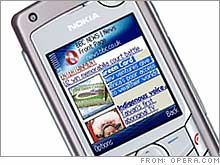 A healthy debate on the future of the unwired Web is likely to take place at two events this week: The CTIA Wireless Association trade show in Orlando and the GSM Association's media and entertainment summit in New York. Most Americans who have tried to get to a favorite Web site via cell phone will attest that the process is slow and cumbersome. Part of the problem is perception: Many U.S. consumers are used to surfing the Web using PCs and broadband hookups, so a wireless phone with a 30 kilobit per second connection and a number keypad instead of a QWERTY keyboard certainly will pale in comparison. But many tech types say that U.S. wireless operators are inhibiting the growth of a lively wireless web by encouraging customers to visit Web sites that have paid to be featured on the carriers' mobile Web screens. Carriers typically present these preset menus to customers trying to get onto the mobile Web instead of showing a plain browser that lets users search for any URL they want. The tech community likens these menus to the "walled garden" setups of early online access providers like AOL. "All the pieces are falling into place for quite an interesting wireless mobile ecosystem," says Sean Dalton, a managing general partner with venture capital firm Highland Capital Partners. "The big fly in the ointment is the carriers." The carriers, for their part, have their reasons for seeking to control their users' experiences. They've spent billions of dollars buying wireless spectrum and upgrading their networks for data services, and they'd like to make money selling premium services to their customers. They also contend that their approach optimizes the speed and ease with which consumers get the information they need - and helps guarantee good wireless data experiences. Furthermore, some analysts say, the carriers have done a pretty good job of assembling menus that capture the basic kinds of information people want on the go: weather, sports scores, maps. In contrast, many of the Internet content companies agitating to dismantle the carriers' walled gardens aren't necessarily offering mobile-centric applications of their own. "The content providers still are thinking about analogs to their wireline applications," says Andy Zimmerman, who leads in Accenture's communications client group. But Web purists say consumers should be the ones to decide what applications or Web sites they want access to, and indeed, some cracks in the walled garden are starting to form. A number of handset makers, European carriers and Web companies have banded together to support dotMobi, a domain designed for accessing sites on a mobile phone. "There's no set of commonly accepted standards to make the mobile Internet work," says Neil Edwards, CEO of dotMobi. "That's part of the reason why dotMobi was formed. We have operators: Vodafone, Telecom Italia, the GSM Association, Nokia, Samsung, Ericsson, Google and Microsoft, they've all come together and built a set of standards that we've implemented and publicly deployed, so when General Foods or General Mills builds Web sites they will work across any wireless network." If it is successful, dotMobi and other mobile services outfits will make it much easier for mobile phone users to go directly to the sites they want, bypassing the carriers' preordained choices. Some of this activity has been happening for years, most notably by ringtone purveyors like Jamba, a joint venture of News Corp. (Charts) and VeriSign. Venture investors such as Highland's Dalton think the wireless operators ultimately will have to abandon their current, limited approach to mobile data, much the way AOL and other first-generation online companies eventually did away with their controlled environments. "The only question is which carrier will be the first," he says. One of the carriers may go with a more open mobile data strategy as a point of differentiation, or the entire mobile industry may be pushed by the development of so-called 4G networks, which are being built specifically for data applications. If Dalton is right, and walled gardens inevitably come down, then the real question isn't who will be first, but rather, how the carriers will manage this transition to avoid simply becoming commoditized data network operators, or worse, AOL circa 2002. ______________ |
Sponsors
|


