ConocoPhillips: The anti-ExxonThe Texas-based oil company breaks with the other U.S. majors to support mandatory national regulation of greenhouse gas emissions, reports Fortune's Marc Gunther. NEW YORK (Fortune) -- Here's yet another sign that the debate over climate change has shifted decisively: ConocoPhillips today becomes the first U.S.-based oil company to support mandatory national regulation of greenhouse gas emissions. In so doing, ConocoPhillips breaks ranks with the two biggest U.S. oil companies - ExxonMobil (Charts) and Chevron (Charts) - as well as with the Bush administration. With revenues of $188 billion in 2006, ConocoPhillips (Charts) operates in 40 nations around the world from its headquarters in Bush country - Houston, Texas.
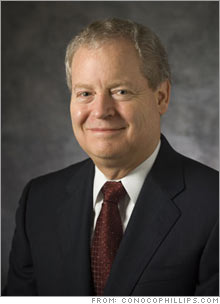
James J. Mulva, the chairman and chief executive of ConocoPhillips, announced the change at a meeting with reporters in Washington, where congressional hearings or industry forums on climate issues are happening almost daily. It's become almost impossible for big companies to stay out of the fray. Mulva said no particular event caused ConocoPhillips to step forward. "We believe that the science is quite compelling," he said. "Human activity, including the burning of fossil fuels, is contributing to climate change. Now is the time we need a national mandated framework to deal with climate change." He didn't endorse a specific regulatory regime. But ConocoPhillips has become the second major oil company - after BP America, a unit of British-based BP (Charts) - to join the U.S. Climate Action Partnership, an alliance of big companies and environmental organizations that support federal action to achieve "significant reductions" in greenhouse gas emissions caused by burning fossil fuels. Other members of the coalition include GE (Charts), Dupont (Charts) and four big green groups - the World Resources Institute, Environmental Defense, the Natural Resources Defense Council and the Pew Center on Global Climate Change. Unlike BP, which has tried to recast itself as a company that goes "beyond petroleum" by touting its (mostly small) investments in renewable energy, ConocoPhillips makes all of its money - about $15.5 billion last year - from producing, refining and selling oil, gas and petrochemicals. That isn't likely to change anytime soon, Mulva said: "The old Conoco and the old Phillips have been oil companies for many, many years. We expect to be an oil company for a long time. Whatever we can produce, we sell. And our refineries are running at the max." He did say that ConocoPhillips' investment in alternative and renewable energy would grow from about $100 million in 2006 to about $150 million this year. But the company defines alternatives broadly, to include the process of extracting oil from the sands of western Canada as well as efforts to develop cellulosic ethanol. Last year, ConocoPhillips began producing renewable diesel fuel from vegetable oil and animal fats at a refinery in Ireland. ConocoPhillips is such a newcomer to the climate debate that it has yet to even calculate its own carbon footprint. The company says it will set public targets for reducing its own greenhouse gas emissions later this year. Low-key and publicity-shy, Mulva quietly acknowledged that regulation of carbon dioxide will impose added costs on the oil industry, and on consumers who buy gasoline, heating oil or natural gas. Higher prices, he said, may be necessary to induce Americans to become more efficient users of energy. The U.S. has less than 5 percent of the world's population but consumes about 25 percent of the world's oil production. After the press event, Mulva told me that he'd reflected personally on the issue of climate change for about a year or so; he travels about 180 days a year, and has heard government officials, environmental groups and scientists sounding alarms over the issue. William K. Reilly, former administrator of the U.S. Environmental Protection Agency and a member of ConocoPhillips' board, was among those urging the company to act. Now, Mulva said, there's no time to waste. "Voluntary programs are not going to meet the challenge of climate change," Mulva said. "The longer we wait - two or five years or more from now - it won't be mitigation, it will be adaptation." Yes, that's the CEO of a Texas-based oil company talking. ________________ |
|