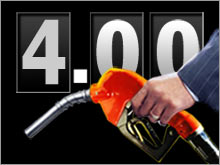
Get ready for $4 gasolineEven with prices at record highs, demand and refining problems could push them much higher. Any relief in sight?NEW YORK (CNNMoney.com) -- With gas prices at record highs, experts say $4-a-gallon gasoline is just around the corner. "I think it's going to happen," said Phil Flynn, a senior market analyst at Alaron Trading in Chicago. "Unless things change dramatically, I think we're going to see $4 a gallon."
Already, prices in California average $3.48 a gallon, according to the motorist organization AAA. And one service station in San Francisco was charging $3.95, according to GasBuddy.com, a handy site that lists the cheapest and most expensive gas stations by city and state across the country. Refinery problems and strong demand are the two main reasons cited for the runup. Prices hit a record high of $3.087 a gallon Tuesday, the third record-setting day in a row, according to AAA. Refinery output in the United States has been below normal for several months now, after fires and other accidents combined with longer than normal maintenance shutdowns, hurting production. Peter Beutel, an oil analyst at consulting firm Cameron Hanover, noted in a recent report that refineries have not operated above 95 percent capacity since Hurricanes Rita and Katrina in 2005. Before 2005, the refineries, clustered around the Gulf coast and badly damaged in the storms, routinely operated at over 95 percent capacity. Flynn said gasoline stocks have fallen for the past twelve weeks straight and are now at their lowest level for this time of year since 1956. This all comes just as the nation gears up for the summer driving season, spurred by vacationing families and out-of-school students. Meanwhile, demand has shown no sign of easing. That's despite a nationwide average price of $3.07 a gallon for unleaded regular, a record, according to Trilby Lundberg, publisher of the Lundberg Survey of thousands of stations nationwide. During the winter months gasoline demand grew at about 2.5 percent, according to the Energy Information Agency. Average demand growth is about 1.5 percent. "More and more communities are going to see gasoline that approaches or exceeds $4 a gallon," John Kilduff, an energy analyst at Man Financial in New York, said recently. "Where we're currently at with prices, that's a given." But not everyone is so convinced. Wholesale gasoline prices have fallen 20 cents over the last week and prices for gasoline futures on the New York Mercantile Exchange have lost about the same amount over two weeks, according to Tom Kloza, chief oil analyst at the Oil Price Information Service, which gathers statistics for AAA. Kloza said gasoline prices as measured by AAA have not yet hit a record, clocking in at $3.04 a gallon Monday, two cents shy of the 2005 record. "I'm not sure we're going to get there," said Kloza. "I wouldn't be surprised to see our numbers stay the same, or maybe even tick lower." When inflation is factored in, Lundberg's record of $3.07 still trails the all-time high in March 1981. At the time, gasoline cost $1.35 a gallon - and in today's dollars, that's $3.13 a gallon, said Lundberg. Also, Americans earn a lot more now than they did in the early 1980s, so by some measures what people spend now on gas is only half of what is used to be. In 1980, the average American had to work 105 minutes to buy enough gas to drive the average car 100 miles, David Wyss, chief economist at Standard & Poor's, said in a study last year. By 2006, the average American needed to work only 52 minutes, thanks in part to better fuel efficiency but mostly due to higher wages. It's also worth noting that while $4 gasoline would be a record for American motorists, in Europe it's common due to high taxes. The average price for a gallon of gas in the Netherlands is over $7, and it's over $6 in many European countries. |
| |||||||