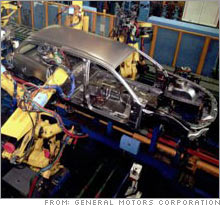
Doomed GM plant is most productiveRankings show GM plant slated to close takes least time of any in North America to assemble a car.NEW YORK (CNNMoney.com) -- The most productive auto plant in North America is doomed - it's on the list of plants that General Motors is closing as the world's largest automaker slashes capacity in a bid to stem losses. The annual ranking of auto plant productivity by Harbour Consulting found GM's Oshawa No. 2 plant is the most productive in the North American auto industry.
That plant is among the plants that GM (Charts, Fortune 500) plans to close in coming years as it seeks to get capacity closer in line with demand. The Ontario plant, which makes the Pontiac Grand Prix and Buick LaCrosse and Allure, took only 15.68 hours on average to build a vehicle in 2006. That's an improvement from the 16.08 hours it took in 2005, and is better than the 16.34 hours it takes to build a vehicle at the neighboring Oshawa No. 1 GM assembly line. The No. 2 plant was originally slated to close when it's done making 2008 models about this time next year. But GM now plans to keep some production going there for an undetermined amount of time as it modernizes the Oshawa No. 1 plant to give that facility a more flexible assembly line. Oshawa No. 2 was the second most productive plant in last year's rankings but the only plant that was more productive, an Atlanta plant that built the Ford Taurus, was closed last year when Ford (Charts, Fortune 500) discontinued production of that model. GM announced in November 2005 that it would close Oshawa 2, as well as a dozen other facilities. A spokesman for GM was not immediately available for comment Thursday. But a year ago when the rankings showed that a plant slated for closure was its most productive, GM spokesman Dan Flores said the decision to close the Ontario assembly line was based on a number of factors, not just productivity. "We obviously do have plants that perform well in the Harbour report being impacted," he said at that time. "We faced a very difficult fact that we have too much manufacturing capacity compared to what the market wants." The rankings also showed that GM has the most productive engine plant in the North American industry in Spring Hill, Tenn., and the most productive transmission plant in Toledo, Ohio. GM put out a statement talking about its gains in productivity, but not mentioning that the Oshawa No. 2 plant is one of those slated for closure. "GM's leadership in three of the four manufacturing categories demonstrates we are transforming the company for sustainable, long-term success," said a statement from Gary Cowger, GM group vice president of global manufacturing and labor relations. "This success is a result of our people being involved in the business like never before." Even with productivity improvements at the traditional Big Three automakers, Toyota Motor (Charts) led Harbour's ranking of productivity for all auto facilities, while Honda Motor (Charts) had the most productive assembly plants, with an average of 21.13 hours per vehicle. But the report showed that GM, Ford and Chrysler Group, which is being sold by DaimlerChrysler, made gains and narrowed the productivity gap with the Japanese automakers' U.S. plants. "Improving productivity in the face of lower production is a huge accomplishment, but none of the domestic manufacturers can afford to let up," said Ron Harbour, president of Harbour Consulting. "General Motors essentially caught Toyota in vehicle assembly productivity." Ford lost an average of $5,234 on every North American-produced vehicle, according to the Harbour study, while GM lost $1,436 and Chrysler lost $1,072. Meanwhile, Japanese automaker Nissan (Charts) earned a pretax profit of $1,575 for each North American vehicle, while Honda earned $1,368 and Toyota, $1,266. The cuts by the U.S.-based automakers mean that they're likely to continue to show gains in productivity. "Considering that they will be building vehicles in 2007 with dramatically fewer hourly employees in the U.S., GM, Ford and Chrysler likely will reduce their hours per vehicle significantly," said Harbour. |
Sponsors
|